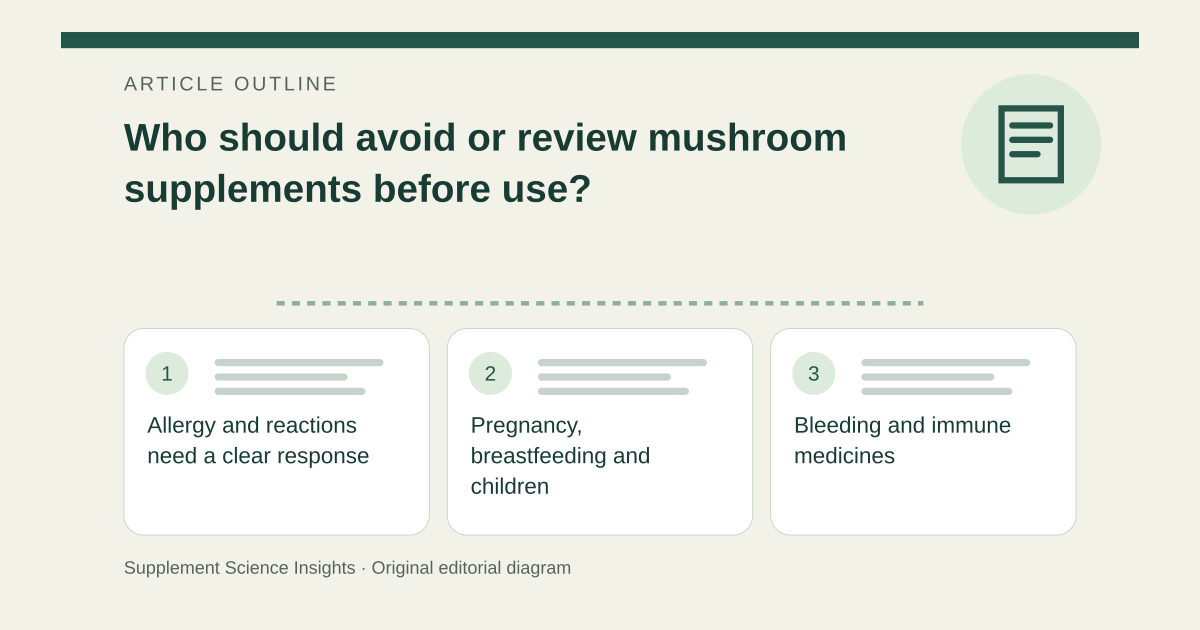
Allergy and reactions need a clear response
Avoid a product containing an ingredient that has caused an allergic reaction. OPSS reports allergic and gastrointestinal reactions with mushroom supplements, and MSK lists nausea, abdominal discomfort and rash with lion’s mane. Stop a product that causes a concerning reaction and seek appropriate care rather than treating symptoms as detoxification. [1][2]
Pregnancy, breastfeeding and children
NIH advises extra caution with supplements in pregnancy, breastfeeding and children because many have not been adequately tested in these groups. Adult supplement labels and edible-mushroom history do not supply pediatric or pregnancy safety data. Review a specific product with the relevant clinician before use. [3]
Bleeding and immune medicines
MSK warns that reishi may increase bleeding risk with anticoagulants or antiplatelets and may oppose the intended effects of immune-suppressing treatment. These are reasons to review reishi with the prescriber, especially around procedures or transplantation. Do not stop prescribed medicine to make room for a supplement. [4]
Kidney and liver disease change the decision
NKF cautions that herbal supplements can create kidney, contamination and medication-interaction risks, particularly with CKD or a transplant. MSK also describes liver injury reports involving reishi products. These reports do not prove that every mushroom has the same risk, but they undermine a blanket claim that extracts are harmless because mushrooms are natural. [5][4]
Cancer treatment and complicated blends
Cancer treatment should include a review of all supplements. MSK describes possible reishi interactions and uncertain clinical significance for some laboratory findings. OPSS notes little safety information for many mushroom combinations. The oncology team needs the complete label, not just the word mushroom. [4][1]
Bring the actual bottle to the review
Imagine a transplant recipient considering an immune-support blend with reishi. The next step is to show the full ingredient list to the transplant pharmacist. Choosing a lower dose without review does not establish that the mixture is compatible with immune suppression. [5][4]
| Situation | Reason for review |
|---|---|
| Known allergy | Re-exposure risk |
| Pregnancy or childhood | Limited safety data |
| Transplant or bleeding medicine | Interaction concerns |
| Kidney or liver disease | Organ-specific safety |
Sources for this article
- Mushroom Dietary Supplements
Source consulted: 2026-09-21. This is a reference resource, not a claim that we conducted the studies or tested a product. - Lion's Mane Mushroom | Memorial Sloan Kettering Cancer Center
Source consulted: 2026-09-21. This is a reference resource, not a claim that we conducted the studies or tested a product. - Dietary Supplements: What You Need to Know
Source consulted: 2026-09-21. This is a reference resource, not a claim that we conducted the studies or tested a product. - Reishi Mushroom | Memorial Sloan Kettering Cancer Center
Source consulted: 2026-09-21. This is a reference resource, not a claim that we conducted the studies or tested a product. - “Kidney Detox” and Herbal Supplements: What’s Safe and What’s Not | National Kidney Foundation
Source consulted: 2026-09-21. This is a reference resource, not a claim that we conducted the studies or tested a product.