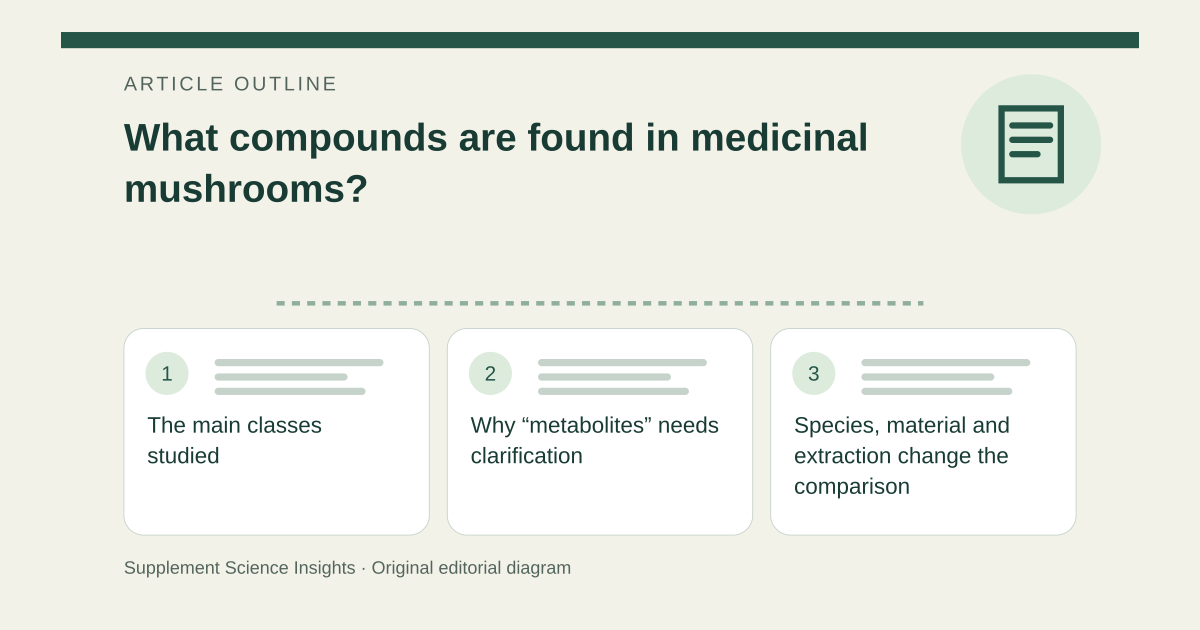
The main classes studied
The term medicinal mushroom covers different fungi, not one standardized chemical mixture. Frequently studied constituents include polysaccharides, such as beta-glucans, and smaller compounds such as triterpenoids. Proteins and lipids can also contribute to a preparation. Which constituents are prominent depends on the species, material used and extraction process. [1]
The National Cancer Institute describes polysaccharides, triterpenoids, lipids and proteins in Ganoderma lucidum preparations. It discusses protein-associated polysaccharide preparations such as PSK and PSP from Trametes versicolor separately. These examples help explain why a result for one named preparation cannot identify the effects of every mushroom powder. [1]
Why “metabolites” needs clarification
In everyday supplement writing, “metabolites” is sometimes used loosely for all mushroom constituents. A more useful first distinction is between large carbohydrate molecules, proteins, lipids and smaller chemical compounds. A polysaccharide and a triterpenoid are different chemical classes; a total amount assigned to one cannot describe the other. [1]
Beta-glucan is also not a synonym for every carbohydrate in a mushroom product. NCI notes that growth substrate can influence the composition of mycelial preparations, including alpha-glucans associated with grain substrates. A general polysaccharide percentage therefore needs an analytical explanation before it can be interpreted as a beta-glucan percentage. [1]
Species, material and extraction change the comparison
A fruiting-body powder, cultured mycelium and an extracted fraction are distinct research materials. An extract can contain a mixture of compounds rather than one purified substance. NCI specifically identifies mixed extraction products as a limitation when investigators try to attribute observed activity to individual Ganoderma constituents. [1]
Some triterpenes have shown activity against cancer cell lines, while others have been weak or inactive in those experiments. A laboratory signal is useful for choosing research questions. It does not establish that swallowing a retail mushroom product treats cancer, and the tested concentrations and exposure route remain important. [1]
Comparing hypothetical mushroom reports
Imagine two reports describe a 30% polysaccharide extract. The matching percentage does not establish matching species, beta-glucan content or triterpenoid composition. To compare them, request the organism name, starting material, extraction method and what the assay actually measured. If one report concerns a specified PSK preparation and the other concerns an uncharacterized mixed powder, their shared mushroom origin is insufficient to transfer the clinical findings. [1]
| Report detail | Question still unanswered |
|---|---|
| 30% total polysaccharides | Which carbohydrates were measured? |
| Ganoderma extract | Which species, material and extraction method? |
| Activity in a cell culture | Does an appropriate human study show a relevant benefit? |
Sources for this article
- National Cancer Institute — Medicinal Mushrooms PDQ
Source consulted: 2026-09-20. This is a reference resource, not a claim that we conducted the studies or tested a product.