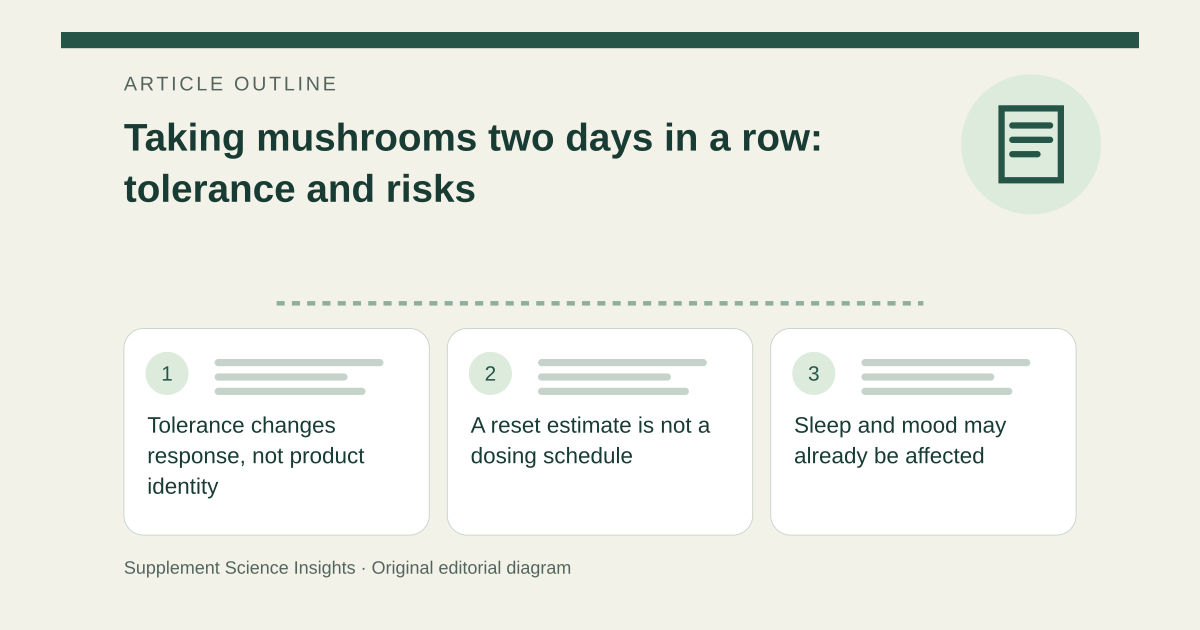
Tolerance changes response, not product identity
NIDA describes rapid tolerance to classic psychedelics. Reduced subjective effects after repeated exposure do not mean the mushroom contains less drug or that blood pressure, judgment and mental-health risks have disappeared. [1]
A reset estimate is not a dosing schedule
Public drug guidance gives approximate recovery periods after stopping, but responses vary with exposure and the person. A fixed number of days cannot certify that the next experience will be predictable. Escalating to overcome tolerance adds uncertainty. [2][3]
Sleep and mood may already be affected
Fatigue, poor sleep, anxiety and other after-effects may continue beyond the most obvious perceptual changes. Repeating use while distressed or sleep-deprived is not an established way to recover or obtain a therapeutic benefit. [3]
Treat a weaker second response as a reason to pause
Imagine the same-looking portion feels weaker the next day. Neither appearance nor the prior response tells someone how much active compound is present. Do not use that comparison to calculate a catch-up amount; seek help if use or after-effects are becoming difficult to manage. [1][3]
| Observation | Not established |
|---|---|
| Weaker second-day effect | Safety |
| Same mushroom weight | Same active content |
| Several days elapsed | Complete individual reset |
| No obvious withdrawal | No potential for harm |
Sources for this article
- Psychedelic and Dissociative Drugs | National Institute on Drug Abuse (NIDA)
Source consulted: 2026-09-21. This is a reference resource, not a claim that we conducted the studies or tested a product. - Psilocybin - Alcohol and Drug Foundation
Source consulted: 2026-09-21. This is a reference resource, not a claim that we conducted the studies or tested a product. - Psilocybin for Mental Health and Addiction: What You Need To Know | NCCIH
Source consulted: 2026-09-21. This is a reference resource, not a claim that we conducted the studies or tested a product.