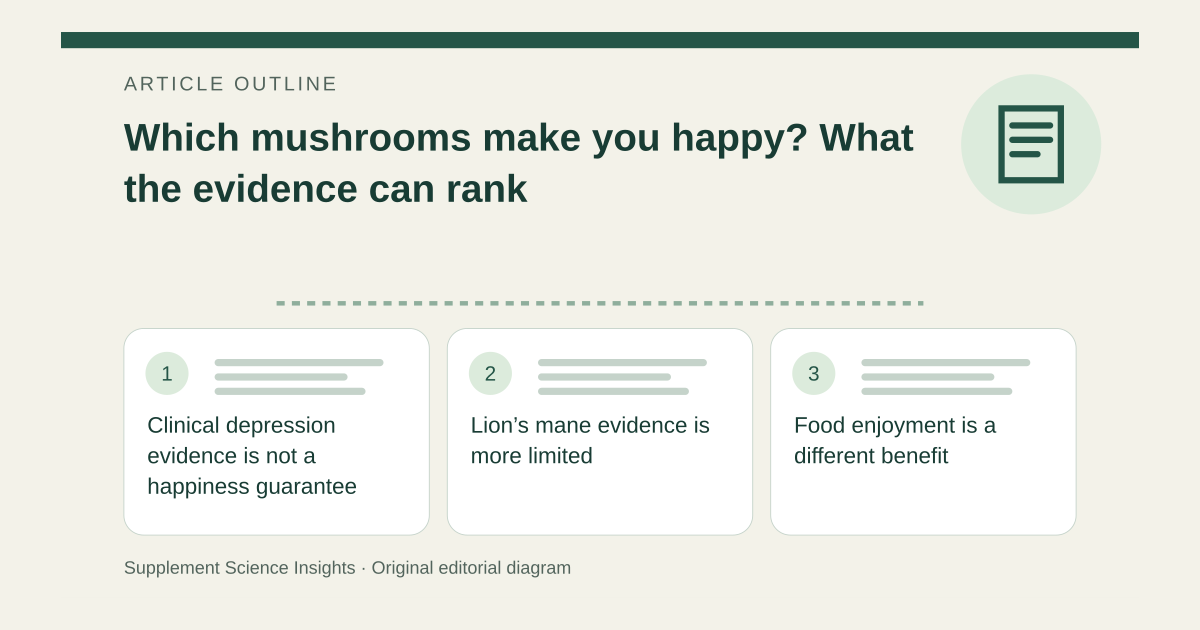
Clinical depression evidence is not a happiness guarantee
A systematic review supports an antidepressant signal for psilocybin in selected research settings. That is not the same as making a healthy person happy, and unsupervised exposure can produce anxiety or panic instead. [1][2]
Lion’s mane evidence is more limited
MSK describes small clinical signals for mood and stress alongside preclinical findings. These do not establish a best mushroom, a dependable antidepressant effect or equivalence across foods and extracts. [3]
Food enjoyment is a different benefit
A savory meal may be enjoyable without treating a mood disorder. Ordinary culinary mushrooms should be evaluated as foods, with attention to the whole diet and personal tolerance rather than a promise of emotional change. [4]
Choose the question before ranking products
Imagine someone with persistent low mood compares a mushroom dinner, a capsule and a psychedelic retreat. The options do not share the same ingredients, evidence or risks. Seek assessment for the mood concern rather than selecting from a happiness leaderboard. [2][3]
| Category | Evidence boundary |
|---|---|
| Supervised psilocybin research | Selected clinical outcomes |
| Lion’s mane extract | Limited clinical data |
| Culinary mushrooms | Food enjoyment and nutrition |
| Best for everyone | No established ranking |
Sources for this article
- Efficacy of psilocybin for treating symptoms of depression: systematic review and meta-analysis - PMC
Source consulted: 2026-09-21. This is a reference resource, not a claim that we conducted the studies or tested a product. - Psilocybin for Mental Health and Addiction: What You Need To Know | NCCIH
Source consulted: 2026-09-21. This is a reference resource, not a claim that we conducted the studies or tested a product. - Lion's Mane Mushroom | Memorial Sloan Kettering Cancer Center
Source consulted: 2026-09-21. This is a reference resource, not a claim that we conducted the studies or tested a product. - Fruit and Vegetable Guide Series: Mushrooms | USU
Source consulted: 2026-09-21. This is a reference resource, not a claim that we conducted the studies or tested a product.