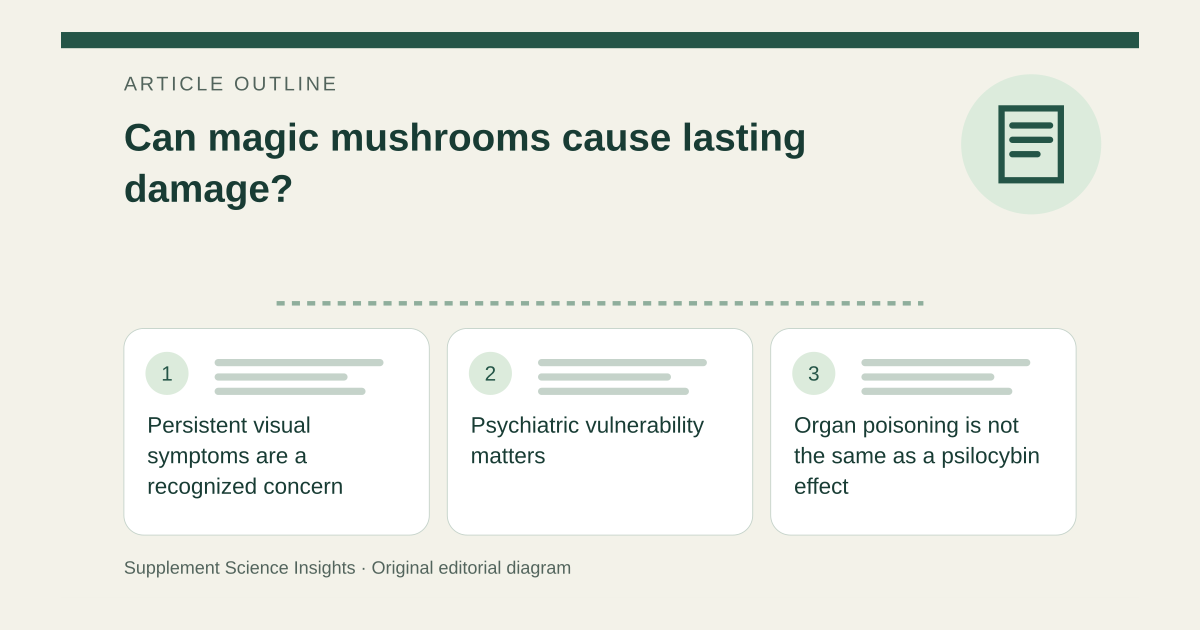
Persistent visual symptoms are a recognized concern
NIDA describes hallucinogen persisting perception disorder, in which distressing perceptual disturbances recur or persist after the acute drug effect. Research is limited and often relies on self-reported exposures, making exact risk estimates difficult. [1]
Psychiatric vulnerability matters
Severe or prolonged psychological effects are uncommon in carefully screened research settings, but that does not establish equivalent safety in unsupervised use. Existing psychotic conditions and other serious mental-health problems require particular caution. [1][2]
Organ poisoning is not the same as a psilocybin effect
A poisonous look-alike may injure the liver or kidneys. Falls and other events during impaired judgment can also cause lasting harm. These mechanisms should not be collapsed into either an all-mushrooms-damage-the-brain claim or a no-physical-risk claim. [3]
Persistent symptoms deserve evaluation
Imagine visual disturbances or paranoia continue after the expected acute period. Stop further exposure and seek medical assessment. Tell the clinician what was taken, including other substances, and seek emergency help for immediate danger, seizures or loss of consciousness. [1][3]
| Concern | Type of problem |
|---|---|
| Recurrent visual disturbance | Possible persistent perceptual disorder |
| Ongoing paranoia | Psychiatric assessment needed |
| Unknown wild mushroom | Potential organ poisoning |
| Injury during impairment | Separate physical harm |
Sources for this article
- Psychedelic and Dissociative Drugs | National Institute on Drug Abuse (NIDA)
Source consulted: 2026-09-21. This is a reference resource, not a claim that we conducted the studies or tested a product. - Psilocybin for Mental Health and Addiction: What You Need To Know | NCCIH
Source consulted: 2026-09-21. This is a reference resource, not a claim that we conducted the studies or tested a product. - Magic Mushrooms (Psilocybin) Safety | California Poison Control System
Source consulted: 2026-09-21. This is a reference resource, not a claim that we conducted the studies or tested a product.