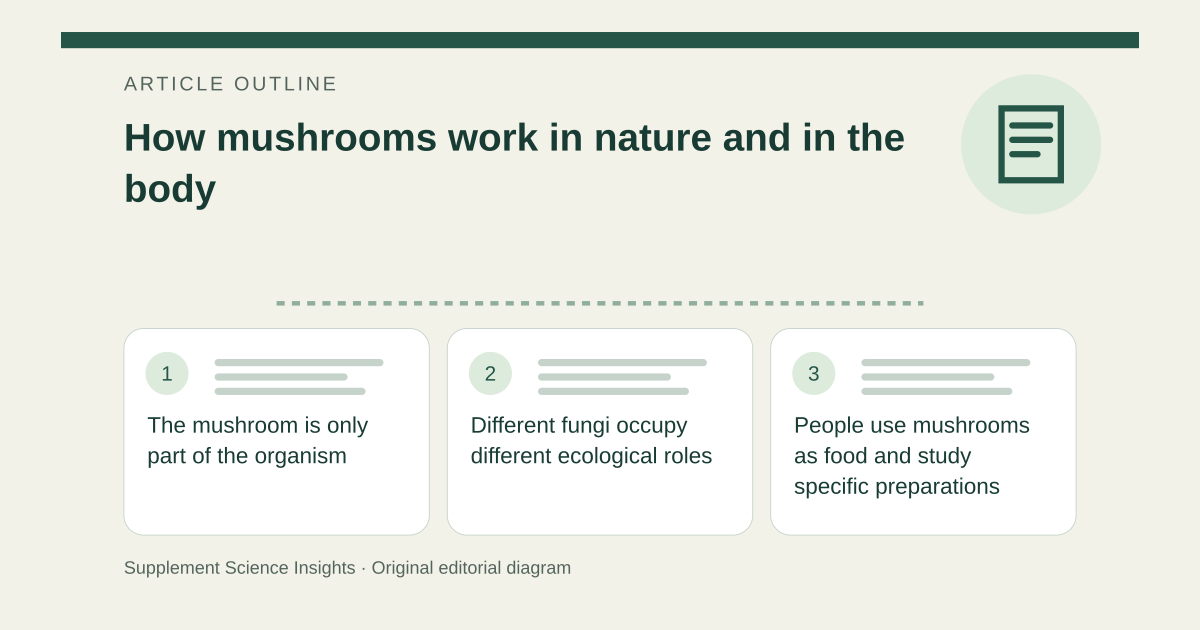
The mushroom is only part of the organism
Threadlike hyphae form a mycelial network that obtains nutrients. Many fungi release enzymes outside their cells, break down complex material and absorb the smaller products. Fruiting structures produce spores; not all fungi form familiar capped mushrooms. [1][2]
Different fungi occupy different ecological roles
Decomposers return nutrients from dead material to ecosystems. Mycorrhizal fungi exchange resources with plant roots, while some fungi parasitize living organisms. These roles differ by species rather than describing every mushroom alike. [2]
People use mushrooms as food and study specific preparations
Culinary mushrooms contribute flavor and nutrients. Research also examines extracts, including particular mushroom-derived preparations alongside cancer treatment. Evidence for a standardized adjunct does not turn an ordinary mushroom meal or retail blend into a medicine. [3][4]
Match the use to the actual organism
Imagine a mushroom grows on decaying wood. That ecological observation neither identifies an edible species nor establishes a health benefit. Use reliably identified food mushrooms; assess supplement claims using human evidence for the exact preparation. [5][6]
| Context | What it means |
|---|---|
| Decaying log | Nutrient recycling |
| Plant-root partnership | Resource exchange |
| Dinner ingredient | Food use |
| Defined clinical preparation | Separate evidence and safety |
Sources for this article
- 24.1 Characteristics of Fungi - Biology 2e | OpenStax
Source consulted: 2026-09-21. This is a reference resource, not a claim that we conducted the studies or tested a product. - 24.3 Ecology of Fungi - Biology 2e | OpenStax
Source consulted: 2026-09-21. This is a reference resource, not a claim that we conducted the studies or tested a product. - Fruit and Vegetable Guide Series: Mushrooms | USU
Source consulted: 2026-09-21. This is a reference resource, not a claim that we conducted the studies or tested a product. - Mushrooms - NCI
Source consulted: 2026-09-21. This is a reference resource, not a claim that we conducted the studies or tested a product. - Preserving mushrooms | OSU Extension Service
Source consulted: 2026-09-21. This is a reference resource, not a claim that we conducted the studies or tested a product. - Mushroom Dietary Supplements
Source consulted: 2026-09-21. This is a reference resource, not a claim that we conducted the studies or tested a product.