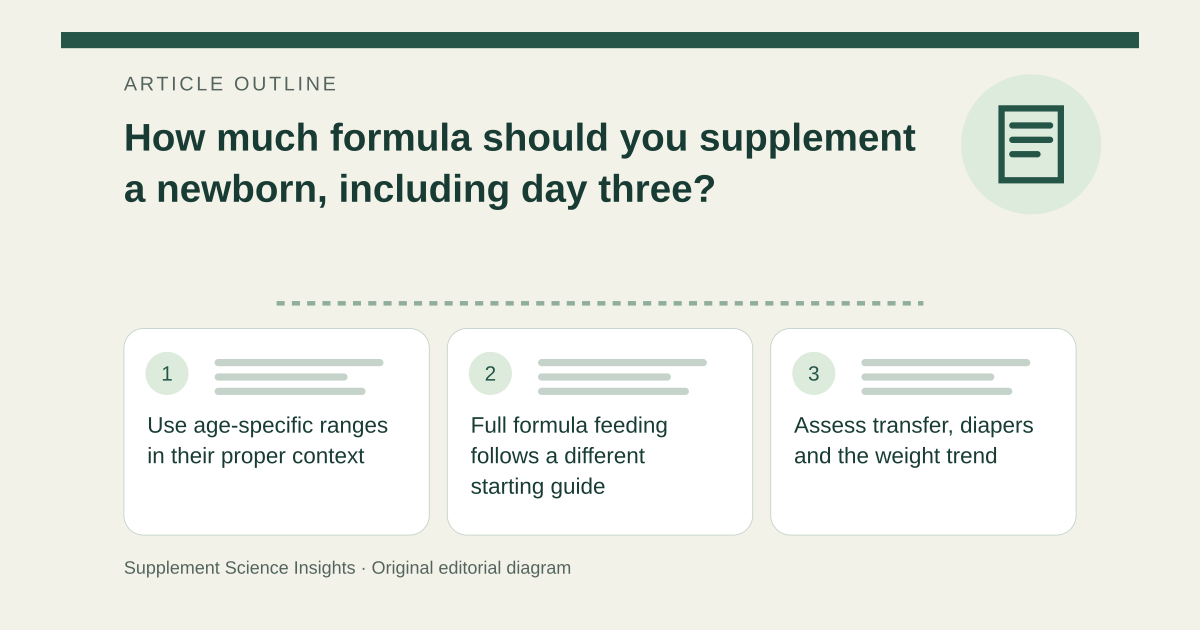
Use age-specific ranges in their proper context
ABM’s guideline reports average colostrum intakes in healthy term breastfed infants: 2–10 mL per feed in the first 24 hours, 5–15 mL at 24–48 hours, 15–30 mL at 48–72 hours and 30–60 mL at 72–96 hours. These are reported total colostrum intakes, not automatic formula top-ups after every breastfeed. A baby described as three days old may be on either side of the 72-hour boundary. [1]
Full formula feeding follows a different starting guide
For newborns receiving only formula and no breast milk, CDC suggests initially offering 1–2 ounces, about 30–60 mL, every 2–3 hours in the first days, responding to hunger cues and discussing the amount with the clinician. Do not add that full amount automatically after an effective breastfeed. Prematurity, illness and feeding problems require their own plan. [2][1]
Assess transfer, diapers and the weight trend
ABM emphasizes a skilled feeding assessment and evaluation of inadequate intake before deciding on supplementation. Poor feeding, unusual sleepiness, dehydration, worsening jaundice or concerning urine/stool output need prompt contact with the newborn team. A difficult-to-wake or clearly unwell baby needs urgent assessment. If maintaining breastfeeding is the goal, discuss expressing milk when supplements replace breast stimulation and how to reassess the need. [1]
Prepare formula safely and avoid forced finishing
Use the exact water-to-powder ratio; do not dilute or concentrate a bottle to change intake. Powder is not sterile. CDC advises additional preparation precautions for infants under two months, including hot-water preparation for powder followed by cooling before feeding. Follow current instructions for the product and infant; ready-to-feed liquid is another option to discuss. Discard leftovers after feeding and follow the stated storage limits. [3]
Make the top-up decision about this feed
Imagine a 60-hour-old baby transfers an uncertain amount at the breast. The 15–30 mL colostrum range does not reveal how much extra that baby needs. An observed feed, clinical assessment and weight/output information help the care team specify the supplement, frequency and follow-up. Do not subtract an unmeasured intake or treat a generic chart as a prescription. [1]
| Observation | What it does not establish |
|---|---|
| A generic amount or average | An individual prescription or quote |
| A related product or study | The same intervention |
| A plausible mechanism | A guaranteed result |
Sources for this article
- ABM Clinical Protocol 3: Supplementary Feedings in the Healthy Term Breastfed Neonate, 2017
Source consulted: 2026-09-21. This is a reference resource, not a claim that we conducted the studies or tested a product. - How Much and How Often to Feed Infant Formula | Infant and Toddler Nutrition | CDC
Source consulted: 2026-09-21. This is a reference resource, not a claim that we conducted the studies or tested a product. - Infant Formula Preparation and Storage | Infant and Toddler Nutrition | CDC
Source consulted: 2026-09-21. This is a reference resource, not a claim that we conducted the studies or tested a product.