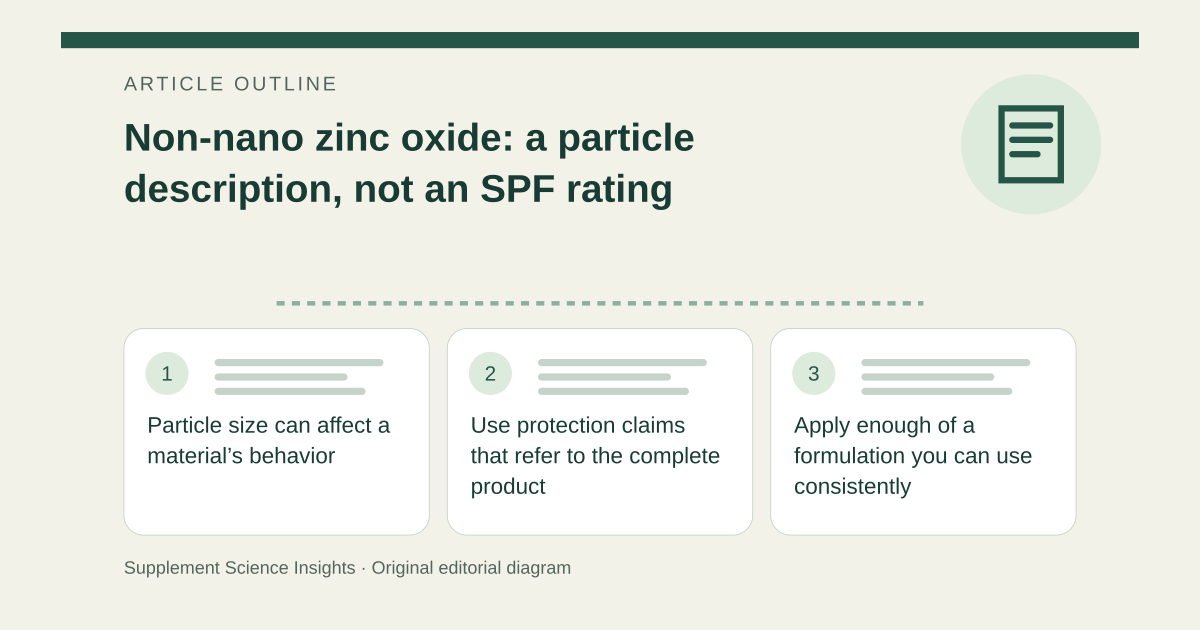
Particle size can affect a material’s behavior
FDA’s nanotechnology report explains that properties can change as material dimensions become very small. In sunscreen discussions, nano and non-nano language concerns the zinc oxide particles, not a different dietary form of zinc. The wording alone does not describe every aspect of the formulation or its testing. [1]
Use protection claims that refer to the complete product
FDA explains that SPF and broad-spectrum labeling address the performance of the sunscreen. A non-nano claim does not assign an SPF, demonstrate water resistance or prove superiority over another formula. Check the active ingredients, broad-spectrum designation and directions on the actual product. [2]
Apply enough of a formulation you can use consistently
Imagine a non-nano lotion leaves a visible film and a reader uses much less to hide it. The particle claim cannot compensate for using a product contrary to its directions. Compare suitable finished formulations and maintain other sun-protection measures instead of making appearance the only selection criterion. [2]
| Name or claim | What it means |
|---|---|
| Non-nano wording | Particle-size description |
| SPF and broad spectrum | Finished-product protection information |
| Visible white film | Not a direct measure of protection |
Sources for this article
- Nanotechnology Task Force Report 2007 | FDA
Source consulted: 2026-09-20. This is a reference resource, not a claim that we conducted the studies or tested a product. - Sunscreen: How to Help Protect Your Skin from the Sun | FDA
Source consulted: 2026-09-20. This is a reference resource, not a claim that we conducted the studies or tested a product.