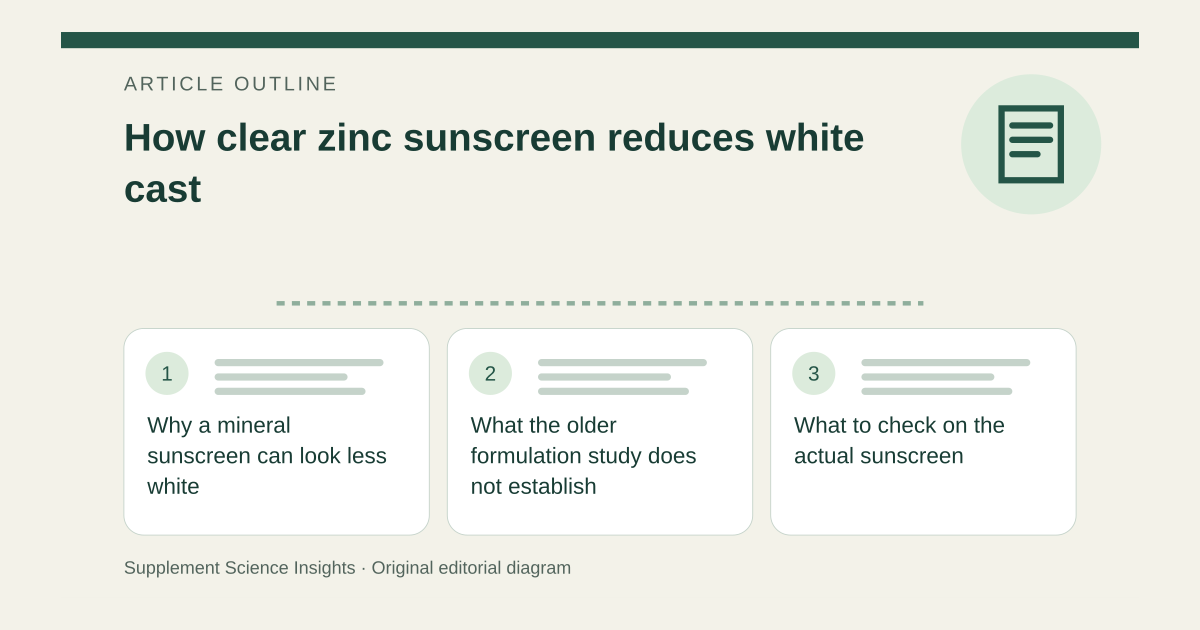
Why a mineral sunscreen can look less white
Zinc oxide interacts with light. Conventional zinc-containing creams can leave a visible white film, while microfine particles and formulation choices can make that film less conspicuous. Clear zinc is a product description, not a separate essential mineral or a guarantee that the lotion becomes completely invisible on every skin tone. [1]
A primary study of microfine zinc oxide examined its ultraviolet attenuation and behavior in test formulations. This supports distinguishing visible transparency from the ability to attenuate ultraviolet light: something can be less obvious to the eye while still affecting wavelengths the eye cannot see. [1]
What the older formulation study does not establish
The 1999 study assessed optical properties, SPF contribution, photostability and photoreactivity using specified methods. It was not a long-term comparison of every modern clear-zinc product or a clinical skin-cancer prevention trial. The inspected abstract does not provide sufficient sample, funding or conflict information for a full appraisal. [1]
Its findings should therefore support the basic formulation explanation, not a claim that all clear-zinc products have identical protection or safety. Particle size, dispersion, other ingredients and the finished formulation need product-specific evidence. [1]
What to check on the actual sunscreen
Use the tested SPF, broad-spectrum designation and directions on the actual product. FDA explains that broad-spectrum protection concerns both UVA and UVB, and that water resistance is a tested, time-limited claim rather than waterproofing. [2]
The active-ingredient panel also matters. A product emphasizing zinc on the front can still contain other sunscreen actives. Neither whiteness nor transparency tells you its complete formula. Reapply as directed and combine sunscreen with other sun-protection measures; do not apply less merely to make a visible film disappear. [2]
Comparing two hypothetical finishes
Imagine a visible white lotion and a less-visible lotion that both declare broad-spectrum SPF 30. The difference in appearance does not, by itself, show that one has a higher SPF. Compare their actual labeling, water-resistance information and suitability for normal use rather than using color as a protection meter. [2][1]
| Feature | Relevant question |
|---|---|
| White cast | How does the film look on skin? |
| SPF and broad spectrum | What protection has the product demonstrated? |
| Water-resistance time | What tested exposure period is stated? |
Sources for this article
- Microfine zinc oxide (Z-cote) as a photostable UVA/UVB sunblock agent.
Source consulted: 2026-09-20. This is a reference resource, not a claim that we conducted the studies or tested a product. - Sunscreen: How to Help Protect Your Skin from the Sun | FDA
Source consulted: 2026-09-20. This is a reference resource, not a claim that we conducted the studies or tested a product.