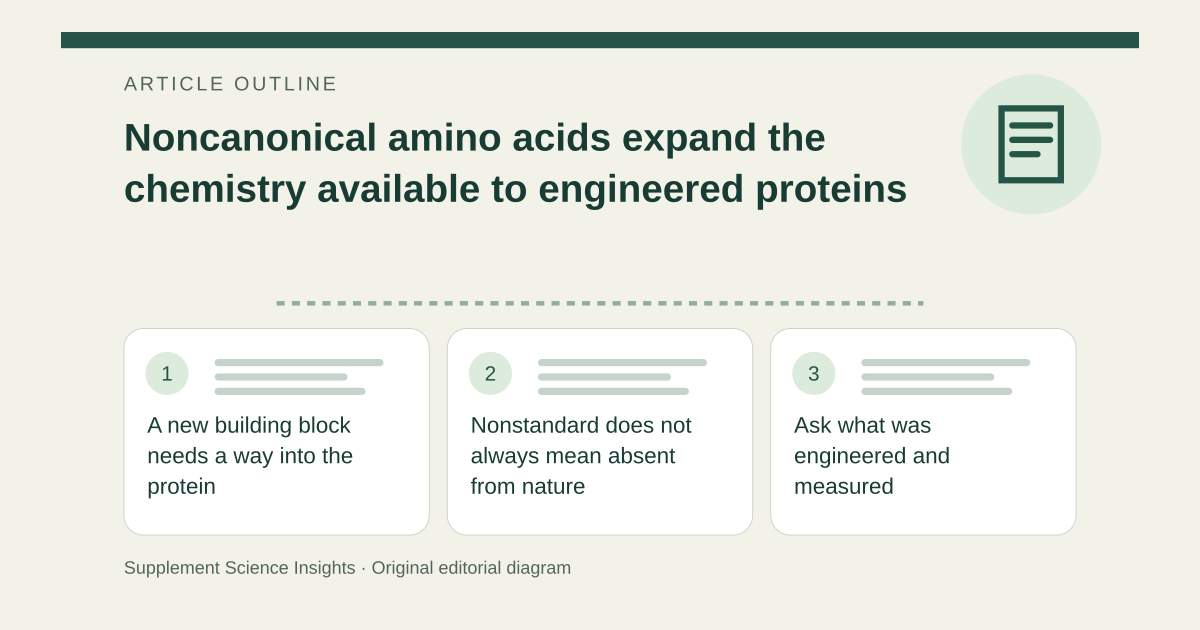
A new building block needs a way into the protein
Genetic code expansion uses engineered translation machinery to place selected noncanonical amino acids at defined protein sites. The added chemistry can provide tools for investigating structure or designing new functions. [1][2]
The review describes an engineered aminoacyl-tRNA synthetase and tRNA pair designed to work separately from the host’s normal machinery. Simply supplying a chemical does not establish selective incorporation. [1][2]
Nonstandard does not always mean absent from nature
RCSB includes naturally modified residues such as hydroxyproline among nonstandard amino acids. Thus, noncanonical and synthetic are not interchangeable descriptions in every context. [1][2]
Identify the residue, incorporation method and measured function. A promising research application is not evidence that a corresponding dietary product improves human health. [1][2]
Ask what was engineered and measured
Imagine a study places one unusual residue at a chosen protein site. Its finding concerns that engineered protein, not the health effect of swallowing the isolated residue.
| Detail | Interpretation |
|---|---|
| Residue identity | Additional chemical possibilities |
| Engineered machinery | Controls incorporation |
| Dietary benefit | Separate unanswered question |
Sources for this article
- Genetic Code Expansion: Recent Developments and Emerging Applications - PMC
Source consulted: 2026-09-18. This is a reference resource, not a claim that we conducted the studies or tested a product. - PDB-101: Learn: Guide to Understanding PDB Data: Small Molecule Ligands
Source consulted: 2026-09-18. This is a reference resource, not a claim that we conducted the studies or tested a product.