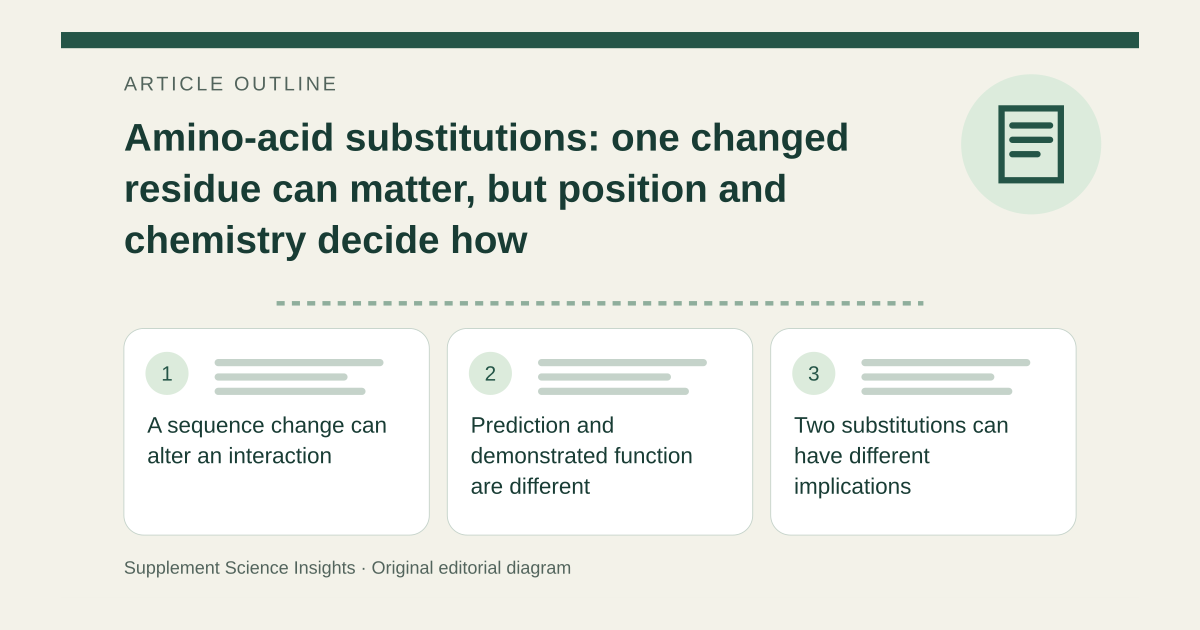
A sequence change can alter an interaction
Replacing one amino-acid residue with another may change size, charge, polarity or the ability to form a particular interaction. If the position is important to folding or an active site, that change can affect function. The number of changed residues alone does not describe the effect. [1]
A substitution at a less constrained position may have little effect, while another can have a major consequence. A sequence difference therefore needs interpretation in its structural and biological context rather than an automatic harmful label. [1]
Prediction and demonstrated function are different
A chemical difference suggests a question to test; it does not by itself quantify the effect on a protein or a person. Relevant evidence can include structural information, functional measurements and clinical observations when applicable. [1]
This is also different from changing the amino-acid content of a meal. Eating one amino acid does not instruct the body to replace a particular genetically encoded residue in a target protein. Sequence-level claims cannot be inferred from supplement composition alone. [1]
Two substitutions can have different implications
Imagine one substitution replaces a small nonpolar side chain with another similar group, while a second introduces a charged group into a tightly packed region. The second raises a different structural concern. Neither hypothetical example establishes a clinical diagnosis without further evidence.
| Feature | Interpretation |
|---|---|
| Position in the protein | Relevant structural context |
| New side-chain properties | Potential interaction change |
| Functional effect | Requires assessment |
Sources for this article
- OpenStax Biology 2e: Proteins
Source consulted: 2026-09-17. This is a reference resource, not a claim that we conducted the studies or tested a product.