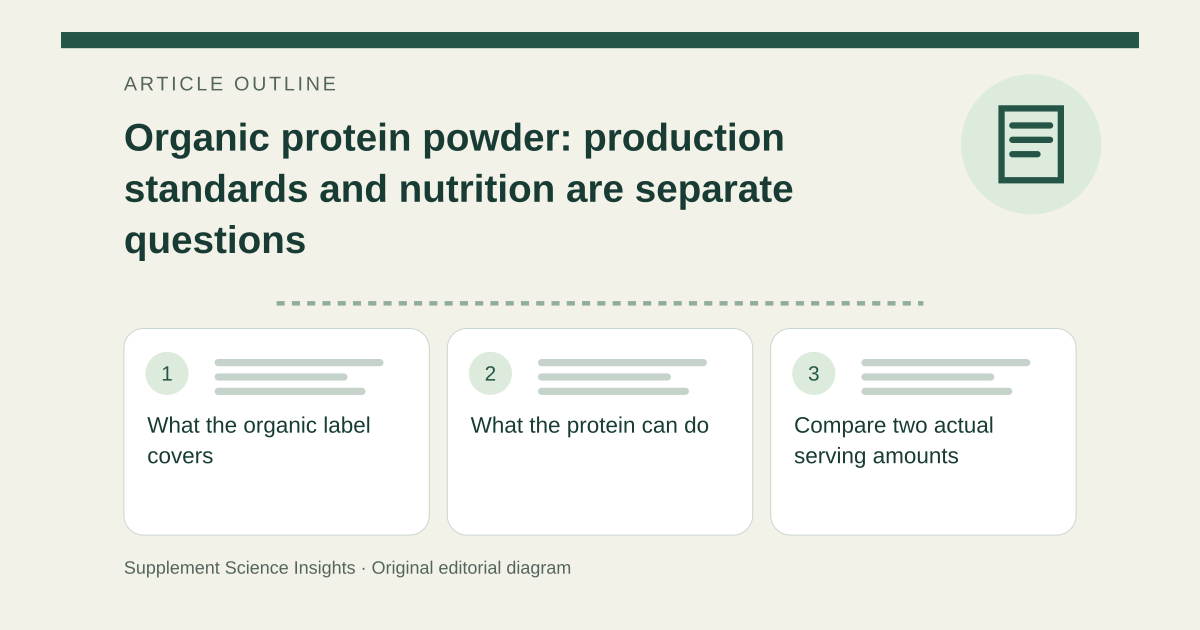
What the organic label covers
USDA organic rules address production, handling and permitted ingredients. For the organic category, at least 95% of ingredients must be organic, excluding salt and water. Made-with-organic labeling is a different category, requiring at least 70% and not permitting the USDA organic seal. These categories do not specify a fixed number of protein grams per serving. [1]
What the protein can do
Adequate protein supplies amino acids for maintenance, repair and training adaptation. An organic powder can contribute to that intake, but its certification alone does not demonstrate a greater muscle-building effect or establish that someone needs supplementation. Read the nutrition information and ingredient source alongside the certification. [2]
Compare two actual serving amounts
Imagine one organic powder declares 18 g protein per serving and a second declares 24 g. Their shared certification does not make those amounts equal. Compare serving weights, full ingredients and your food plan before choosing. This is an illustrative label comparison; it is not a test of contamination, clinical effectiveness or a named product. [2][1]
| Hypothetical claim | What it answers |
|---|---|
| Organic certification | Production and labeling standards |
| 18 g protein per serving | Nutrient amount |
| Better muscle gains | Requires separate outcome evidence |
Sources for this article
- Labeling Organic Products | USDA Agricultural Marketing Service
Source consulted: 2026-09-20. This is a reference resource, not a claim that we conducted the studies or tested a product. - Dietary Supplements for Exercise and Athletic Performance - Health Professional Fact Sheet
Source consulted: 2026-09-20. This is a reference resource, not a claim that we conducted the studies or tested a product.