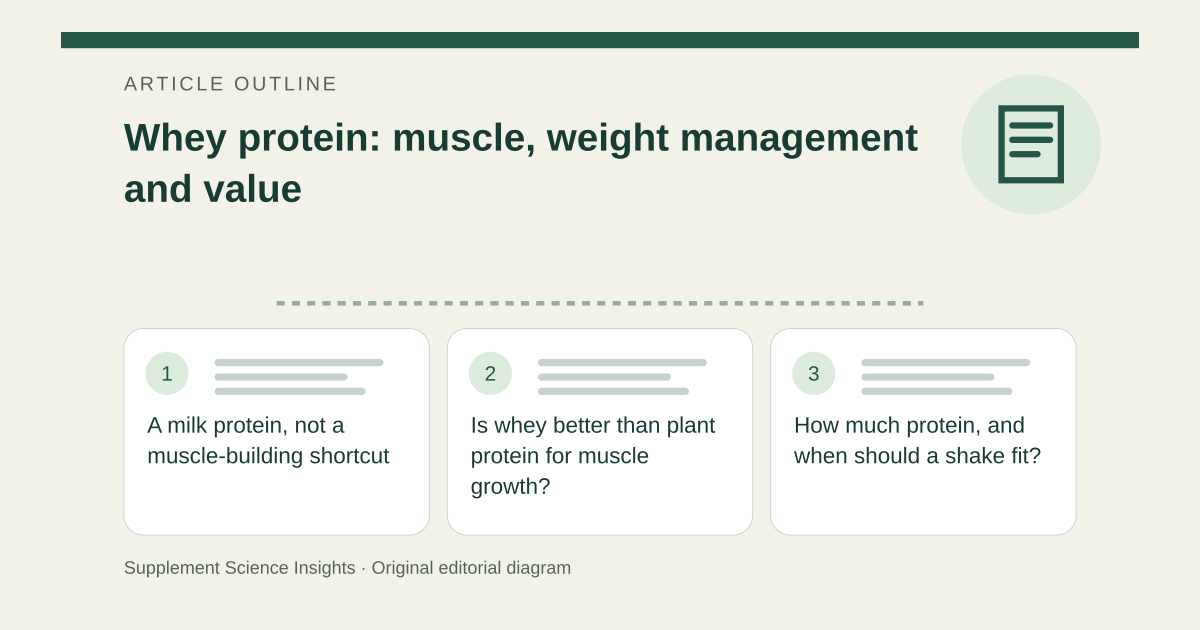
A milk protein, not a muscle-building shortcut
Whey is a protein derived from milk. It supplies all nine essential amino acids, including the branched-chain amino acids leucine, isoleucine and valine. These are materials the body uses to make proteins; their presence does not mean every person needs a separate powder. [1]
The useful starting question is whether a shake fills a practical gap in food intake. A convenient way to reach an appropriate protein intake is different from an ingredient that produces additional muscle regardless of diet or training. [1]
Is whey better than plant protein for muscle growth?
Whey can help meet protein needs, but it is not the only workable protein source. A 12-week study of 38 young men compared habitual vegans and omnivores during supervised resistance training. Total intake was adjusted to about 1.6 g/kg/day with soy or whey. Muscle and strength gains were similar between groups. [3]
This was a comparison of whole diets plus supplementation in previously untrained young men, not a head-to-head test of every powder. It supports adequate plant-based protein as an option in that setting; it does not prove that all products, doses or populations respond identically. [3]
How much protein, and when should a shake fit?
For athletes, NIH ODS summarizes daily protein intakes around 1.2–2.0 g/kg, with needs influenced by training and energy intake. Count protein from meals before deciding how much a powder would add. The supplement fills a gap; the daily total is not a powder-only allowance. [1]
A practical routine spreads protein-containing meals across the day and places a shake where food is inconvenient. Do not treat a few minutes after training as an all-or-nothing deadline. Older age, a low appetite, deliberate weight loss and a medically prescribed protein restriction warrant different planning rather than one scoop count for everyone. [1]
Weight management, bloating and lactose intolerance
A protein powder is not a weight-loss medicine. Compare the calories and protein of the prepared drink, including milk, sweeteners and other additions. Adding a shake to an unchanged diet and using one to replace a less useful snack are different choices. [2]
If a shake causes bloating, examine the serving size, lactose, sugar alcohols and other ingredients before blaming all protein. Isolate and concentrate are processing categories, not guarantees that a finished product is lactose-free. Whey is still unsuitable for someone who must avoid milk protein because of allergy, even if lactose has been removed. [2]
Compare value per gram of protein, not per scoop
For a fictional $30 tub with 30 servings of 20 g protein, the container supplies 600 g of declared protein: $0.05 per gram, or $1 for 20 g. A second tub with fewer larger scoops should be compared using the same arithmetic. These are teaching numbers, not current prices or purity measurements.
Check the full ingredient list for a sweetener preference, verify any claimed independent certification for the exact product, and distinguish a general brand statement from product or batch testing. A heavy-metal report should identify the sample, method and applicable limits. Absence of a public report is an unknown, not proof of contamination or safety.
What exercise research can tell you
The NIH Office of Dietary Supplements describes protein as important for muscle repair and adaptation to training. Requirements depend on activity and the person. Studies of supplements need to be interpreted alongside participants' existing diets: adding protein to an inadequate intake answers a different question from adding it to an already sufficient one. [1]
Whey supplies more leucine than some other commonly studied proteins. That difference alone is not a guarantee of greater long-term strength. A short-term measurement of muscle protein synthesis also does not tell you how much muscle a particular person will gain over months. [1]
Compare the nutrient, then the convenience
Read the protein line separately from scoop weight. Flavors and other ingredients occupy part of a serving, so a 35-gram scoop need not supply 35 grams of protein. A larger container or scoop does not necessarily provide more protein per dollar.
Next consider how the powder fits an actual meal or training day. A person who regularly misses a convenient food option has a different problem from someone seeking an extra effect after already meeting their needs. Keep those decisions separate when comparing products.
Milk allergy is different from lactose intolerance
Milk allergy involves an immune response to milk proteins; lactose intolerance involves difficulty digesting the milk sugar lactose. Whey remains a milk protein even when a product contains little lactose. A low-lactose claim is therefore not a milk-allergy safety claim. [2][1]
If a medical condition requires a prescribed diet or protein restriction, check a proposed supplement with the clinician managing that plan. Do not infer suitability from research in healthy exercising adults. [2][1]
Two hypothetical scoops, the same protein
Imagine powder A provides 24 grams of protein in a 30-gram serving and powder B provides 24 grams in a 40-gram serving. Both supply the same stated protein per serving. Their protein concentrations are 80% and 60%, respectively.
That arithmetic helps compare labels; it does not rank flavor, tolerance, ingredient quality or clinical benefit. Choose the relevant measure before deciding what the bigger number means. Compare servings on the same basis before considering the headline on the tub.
| Label item | Powder A | Powder B |
|---|---|---|
| Serving mass | 30 g | 40 g |
| Protein | 24 g | 24 g |
| Protein fraction | 80% | 60% |
Sources for this article
- NIH ODS — Exercise and Athletic Performance, professional fact sheet
Source consulted: 2026-09-17. This is a reference resource, not a claim that we conducted the studies or tested a product. - NIDDK — Definition and Facts for Lactose Intolerance
Source consulted: 2026-09-17. This is a reference resource, not a claim that we conducted the studies or tested a product. - Hevia-Larraín et al. — High-Protein Plant-Based Diet Versus a Protein-Matched Omnivorous Diet
Source consulted: 2026-10-28. This is a reference resource, not a claim that we conducted the studies or tested a product.
Considering a supplement?
Ingredient evidence alone does not establish which retail product is suitable. The featured option illustrates the label and formulation context above; it is not a clinical efficacy ranking.
Compare whey protein formulations (retail checks pending) → No overall winner
Compare formulations → · How we select products