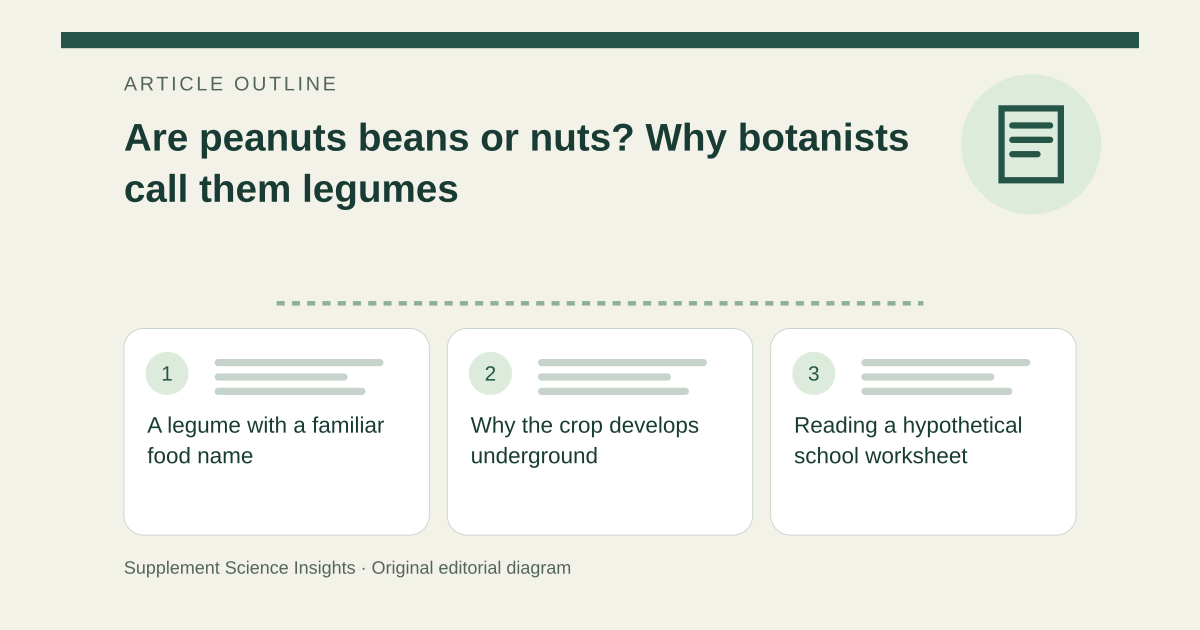
A legume with a familiar food name
The cultivated peanut is Arachis hypogaea, a member of the legume family. It is related to beans and peas, but is not the same species as a kidney bean. Nut is widely used as a culinary name; that usage does not determine the botanical family. Groundnut is another common name for the peanut, not a separate explanation of its anatomy. [1]
Why the crop develops underground
Kew describes the unusual growth process as geocarpy. Peanut flowers are above ground; after pollination a stalk elongates toward the soil, where the peanut develops. The underground location therefore does not mean the part being harvested is a root. Following the flower-to-fruit sequence explains more than simply noting where the crop was dug up. [2]
Reading a hypothetical school worksheet
A worksheet might ask whether a peanut grows on a tree, is a legume, or is a kitchen nut. Those questions use different criteria. The botanical answer is legume; the culinary term nut remains common. This classification exercise should not be used to decide what someone with a food allergy can eat. It identifies a plant relationship, not an individual’s clinical tolerance. [1][2]
| Description | What it tells you |
|---|---|
| Arachis hypogaea | The cultivated peanut species |
| Legume | Botanical relationship |
| Develops underground | Growth habit, not proof of a root |
Sources for this article
- Kew — Full of beans
Source consulted: 2026-09-20. This is a reference resource, not a claim that we conducted the studies or tested a product. - Kew — Plant proteins: Can they grow in the UK?
Source consulted: 2026-09-20. This is a reference resource, not a claim that we conducted the studies or tested a product.