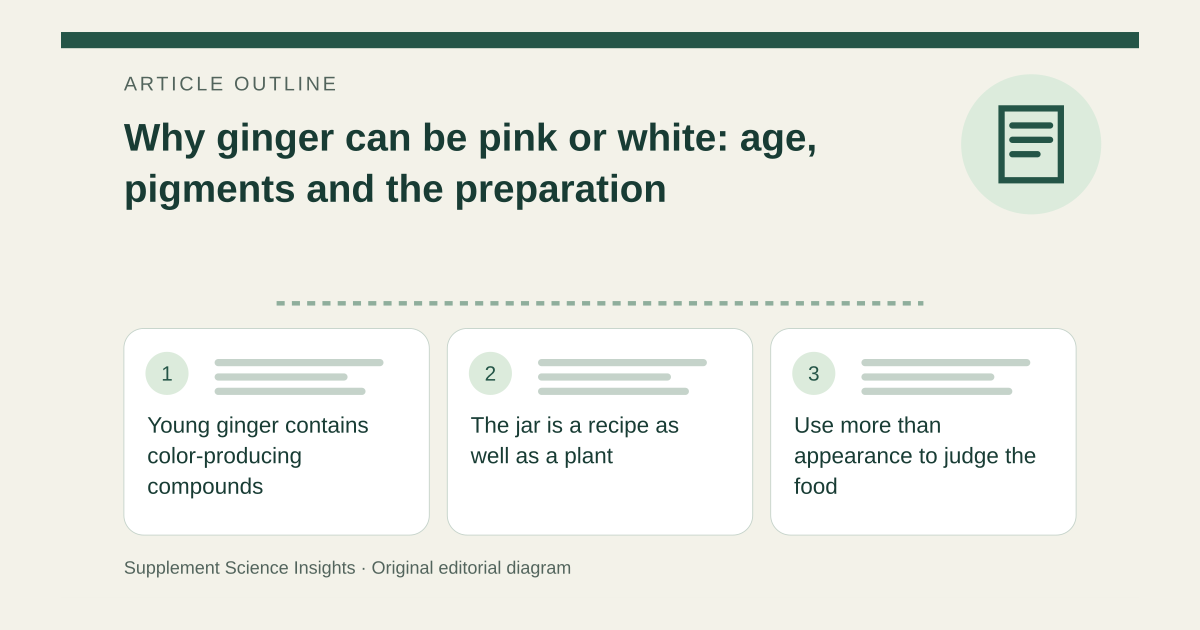
Young ginger contains color-producing compounds
The food-science literature describes anthocyanins in immature ginger that can appear pink under acidic conditions such as vinegar. Iowa State also notes a pink blush on some young ginger. Mature rhizomes differ in pigment, texture and aroma, so not every ginger preparation develops the same color. [1][2]
The jar is a recipe as well as a plant
Pickled ginger is prepared with a pickling mixture, and commercial ingredients need to be checked on the label. A natural color mechanism does not prove how a particular manufacturer obtained its product’s color. Nor does white ginger automatically mean that useful compounds have been removed. [3][1]
Use more than appearance to judge the food
Imagine two properly stored jars differ mainly in shade. Compare ingredients, taste and storage directions rather than ranking one as healthier because it is pink. A normal pigment explanation also should not override spoilage concerns or a damaged package. [4][1]
| Situation | Practical interpretation |
|---|---|
| Young ginger plus acid | Can develop pink coloration |
| Commercial jar | Check the actual ingredients |
| Color alone | Not a complete quality or nutrition test |
Sources for this article
- Pigment Composition Responsible for the Pale Yellow Color of Ginger ( Zingiber officinale ) Rhizomes
Source consulted: 2026-09-20. This is a reference resource, not a claim that we conducted the studies or tested a product. - Storing Fresh Ginger • AnswerLine • Iowa State University Extension and Outreach
Source consulted: 2026-09-20. This is a reference resource, not a claim that we conducted the studies or tested a product. - Quick Tsukemono | Kikkoman Corporation
Source consulted: 2026-09-20. This is a reference resource, not a claim that we conducted the studies or tested a product. - Selecting and Serving Produce Safely | FDA
Source consulted: 2026-09-20. This is a reference resource, not a claim that we conducted the studies or tested a product.