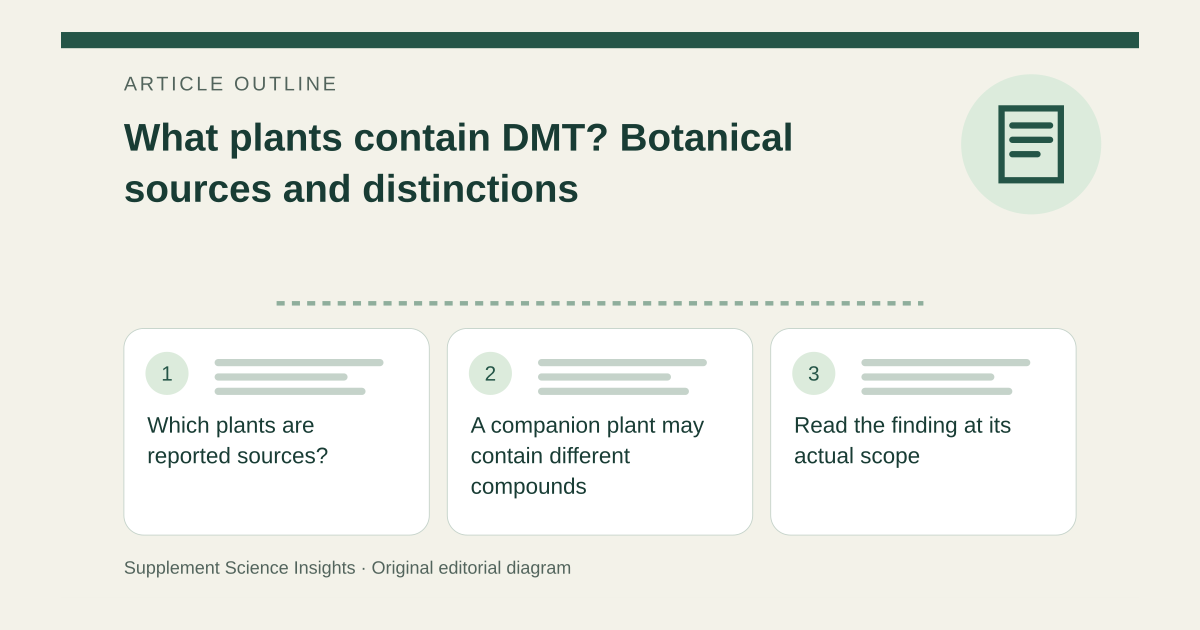
Which plants are reported sources?
A neurobiological review describes Psychotria viridis and P. carthagenensis, Diplopterys cabrerana, Mimosa hostilis and Acacia confusa among botanical sources discussed in DMT research. These names refer to different plants, not interchangeable supplements. Species identity and the material studied matter when interpreting a chemical report. [1]
A companion plant may contain different compounds
Banisteriopsis caapi is principally discussed for harmala alkaloids that inhibit monoamine oxidase, rather than as the main DMT source. Combining substances that affect metabolism changes exposure and risk. A traditional name for a mixed preparation therefore does not identify its full chemical composition or establish safety. [1]
Read the finding at its actual scope
Imagine a botanical paper detects an alkaloid in one specimen. That supports a chemical observation; it does not validate an online product, a therapeutic claim or a home preparation. The review concerns potent psychoactive pharmacology and unresolved clinical questions. Botanical origin alone is not a reason to ingest a plant or combine it with medicines. [1][2]
| Claim | What it establishes |
|---|---|
| Mechanism or product name | A question to investigate |
| Matching human outcome | Evidence needed for a benefit claim |
| Individual suitability | Requires the actual formulation and context |
Sources for this article
- Neurobiological research on N,N-dimethyltryptamine (DMT) and its potentiation by monoamine oxidase (MAO) inhibition: from ayahuasca to synthetic combinations of DMT and MAO inhibitors - PMC
Source consulted: 2026-09-21. This is a reference resource, not a claim that we conducted the studies or tested a product. - Dietary Supplements: What You Need to Know - Consumer
Source consulted: 2026-09-21. This is a reference resource, not a claim that we conducted the studies or tested a product.