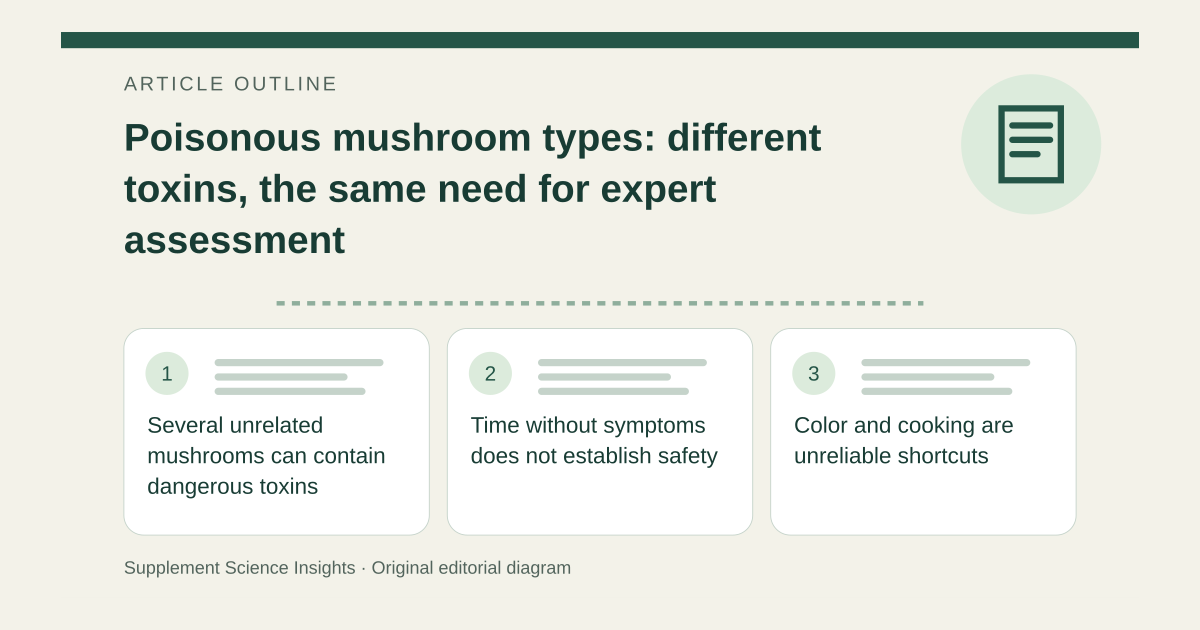
Several unrelated mushrooms can contain dangerous toxins
The HUS Poison Information Center identifies death cap (Amanita phalloides), destroying angel (Amanita virosa) and funeral bell (Galerina marginata) as sources of liver-toxic amatoxins. It identifies deadly webcap (Cortinarius rubellus) with kidney-toxic orellanine and false morel (Gyromitra esculenta) with gyromitrin. These are examples, not a complete worldwide inventory. [1]
Time without symptoms does not establish safety
Some dangerous mushroom syndromes are delayed. Early gastrointestinal illness may also temporarily improve before organ injury becomes apparent. If an unknown wild mushroom was eaten, do not wait for a symptom clock or apparent recovery to decide whether to seek poison advice. [2][3]
Color and cooking are unreliable shortcuts
Different species can look alike, and common names can cover different mushrooms. Poison Control warns that cooking does not remove all mushroom toxins. Identification requires expert assessment of the whole specimen and context, not a single photograph or a rule about cap color. [3][4]
Act on a suspected ingestion
In the United States, call Poison Control at 1-800-222-1222 promptly after an uncertain wild-mushroom ingestion. Keep remaining specimens and information about the amount and time for assessment. Collapse, a seizure, trouble breathing or inability to awaken requires emergency services. [3][5]
Treat an unfamiliar mushroom as unidentified
Imagine a mushroom does not resemble any of the five examples above. That does not establish edibility. Use the examples to understand the range of hazards, not to clear everything else for a meal. [3][4]
| Examples | Major concern |
|---|---|
| Death cap, destroying angel, funeral bell | Amatoxins and liver injury |
| Deadly webcap | Orellanine and kidney injury |
| False morel | Gyromitrin poisoning |
| Any unconfirmed specimen | Expert assessment, not list matching |
Sources for this article
- The most poisonous mushrooms in Finland | HUS
Source consulted: 2026-09-21. This is a reference resource, not a claim that we conducted the studies or tested a product. - Highly poisonous death cap mushroom identified in Boise | Idaho Department of Health and Welfare
Source consulted: 2026-09-21. This is a reference resource, not a claim that we conducted the studies or tested a product. - Mushrooms
Source consulted: 2026-09-21. This is a reference resource, not a claim that we conducted the studies or tested a product. - Collecting fungi and mushrooms for identification by the Schutter Diagnostic Laboratory
Source consulted: 2026-09-21. This is a reference resource, not a claim that we conducted the studies or tested a product. - Poison Control: First aid guidelines
Source consulted: 2026-09-21. This is a reference resource, not a claim that we conducted the studies or tested a product.