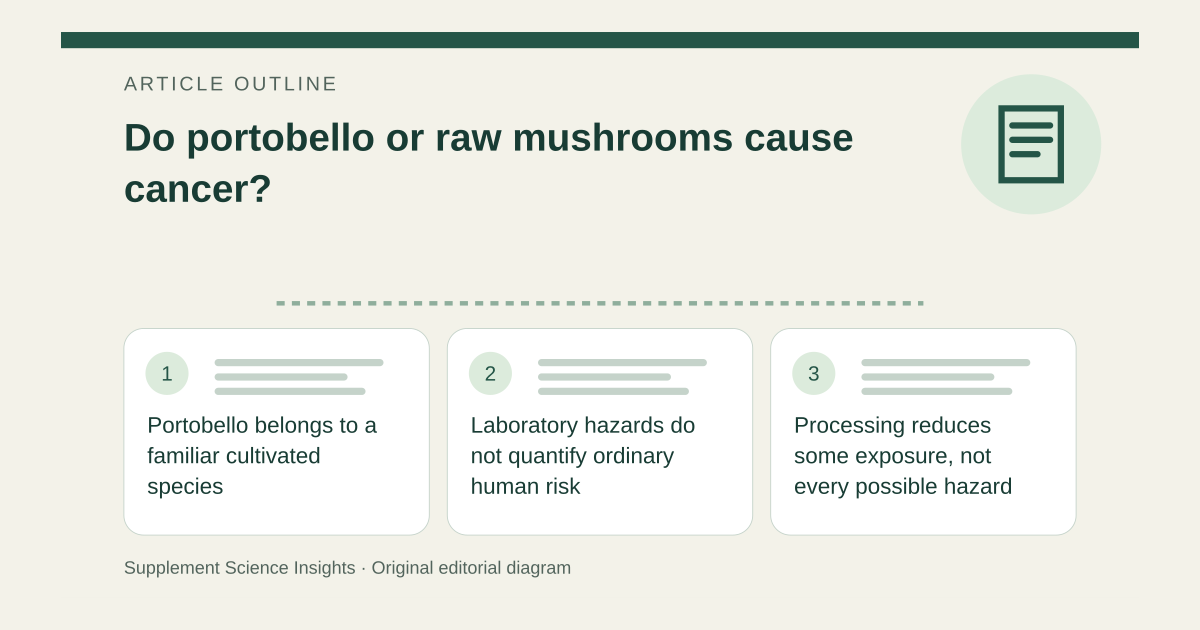
Portobello belongs to a familiar cultivated species
Portobello, cremini and white button mushrooms are forms of Agaricus bisporus at different appearances or maturity stages. Agaritine discussions therefore are not unique to large brown caps. Other mushroom species have different chemical profiles and hazards. [1][2]
Laboratory hazards do not quantify ordinary human risk
A review discusses genotoxicity and animal findings involving agaritine or related compounds. It also notes the absence of demonstrated direct carcinogenic effects from button-mushroom consumption in humans. Experimental concentrations and exposure patterns cannot be treated as a measured risk from one meal. [2]
Processing reduces some exposure, not every possible hazard
The review describes reductions in agaritine with processing, including cooking. Amounts vary with material and method, so an exact universal removal percentage is inappropriate. Cooking an unidentified wild mushroom is not a way to make it safe. [2]
Keep the practical conclusion proportionate
Imagine a claim says portobellos are poisonous because a compound caused an effect in mice. That overstates the human evidence. Choose correctly identified food mushrooms, handle them properly and cook them, while avoiding claims that they either cause or prevent cancer. [2][3]
| Evidence | What it does not show |
|---|---|
| Animal toxicity | Risk from a typical human meal |
| Agaritine present | Human cancer proven |
| Cooking reduces exposure | Universal complete removal |
| Edible cultivated species | Safety of unknown wild specimens |
Sources for this article
- Mushroom Varieties | Mushrooms 101
Source consulted: 2026-09-21. This is a reference resource, not a claim that we conducted the studies or tested a product. - Warning on False or True Morels and Button Mushrooms with Potential Toxicity Linked to Hydrazinic Toxins: An Update - PMC
Source consulted: 2026-09-21. This is a reference resource, not a claim that we conducted the studies or tested a product. - Fruit and Vegetable Guide Series: Mushrooms | USU
Source consulted: 2026-09-21. This is a reference resource, not a claim that we conducted the studies or tested a product.