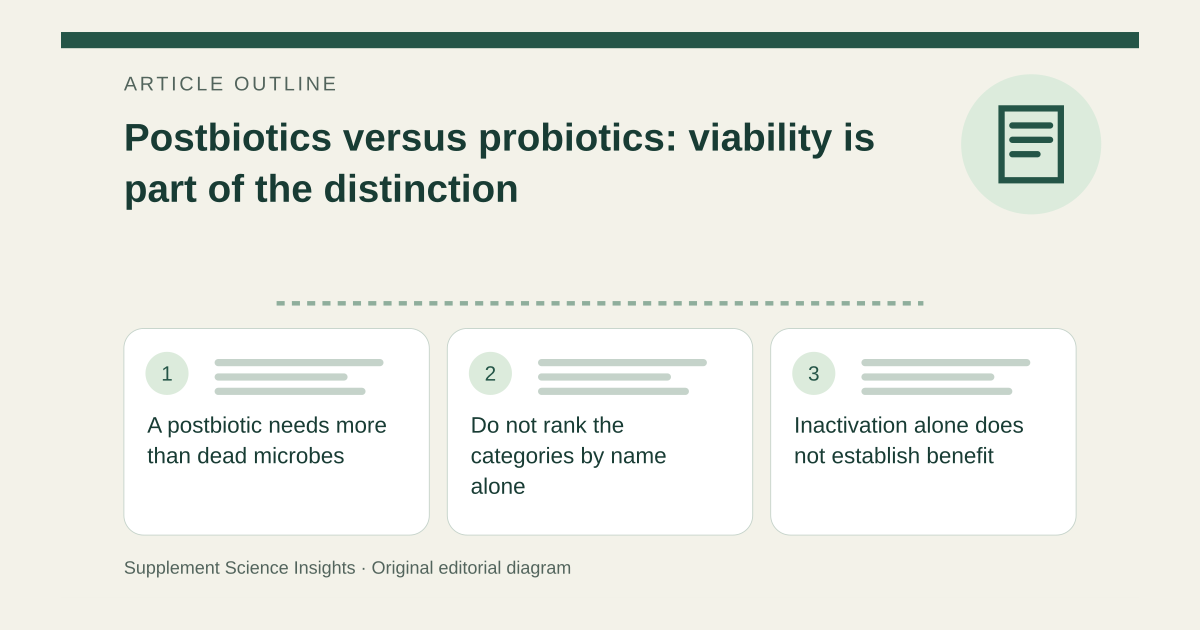
A postbiotic needs more than dead microbes
The consensus requires an inactivated microbial preparation or components and a demonstrated benefit to the host. Metabolites may accompany those components, but the term does not automatically apply to every isolated microbial metabolite. [1]
Likewise, accidentally killing a probiotic culture does not establish that the resulting material is an effective postbiotic. The preparation and evidence still matter. [1]
Do not rank the categories by name alone
A live culture count is relevant to a probiotic formulation, but it is not the same measure of an inactivated preparation. Compare products using evidence appropriate to what they contain and the outcome claimed. [1][2]
The definition is a consensus framework, not a clinical trial showing that all postbiotics are safer or more effective than all probiotics. Those claims require product-specific support. [1][2]
Inactivation alone does not establish benefit
Imagine a live-culture product loses viability during poor storage. Calling the remaining material postbiotic does not demonstrate a health benefit or reproduce a deliberately studied preparation.
| Detail | Interpretation |
|---|---|
| Probiotic | Living microorganisms |
| Postbiotic | Studied inactivated preparation |
| Loss of viability | Not automatic postbiotic evidence |
Sources for this article
- The International Scientific Association of Probiotics and Prebiotics (ISAPP) consensus statement on the definition and scope of postbiotics | Nature Reviews Gastroenterology & Hepatology
Source consulted: 2026-09-17. This is a reference resource, not a claim that we conducted the studies or tested a product. - Probiotics - Health Professional Fact Sheet
Source consulted: 2026-09-17. This is a reference resource, not a claim that we conducted the studies or tested a product.