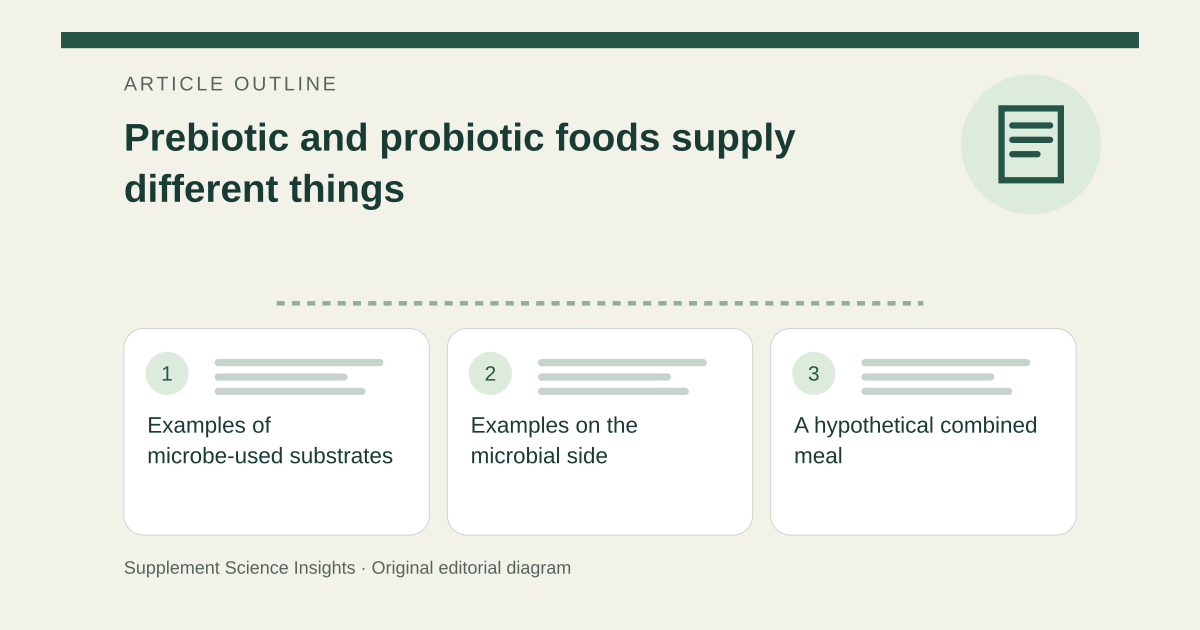
Examples of microbe-used substrates
ISAPP identifies onions, garlic, bananas, chicory root and Jerusalem artichokes as foods containing prebiotic components, often at relatively low levels. A whole food is not necessarily equivalent to the amount of a purified substrate used in research. Not every dietary fiber automatically satisfies the prebiotic definition. [1][2]
Examples on the microbial side
Some yogurts and other foods contain identified probiotic strains. ODS also lists fermented foods such as kimchi and sauerkraut that can contain live cultures without a demonstrated probiotic strain claim. A food can be nutritious even when it does not meet that narrower definition. [3]
A hypothetical combined meal
Imagine banana is paired with a yogurt naming a studied strain. The fruit’s substrate and the yogurt’s microorganism should be recorded separately. Their combination does not automatically establish an extra clinical benefit or make it equivalent to a studied synbiotic formulation. Amounts and the specific research question still matter. [1][3]
| Hypothetical food information | Role |
|---|---|
| Banana or onion component | Potentially microbe-used substrate |
| Yogurt with identified strain | Separate live microorganism component |
Sources for this article
- ISAPP: Prebiotics
Source consulted: 2026-09-20. This is a reference resource, not a claim that we conducted the studies or tested a product. - Probiotics: Usefulness and Safety | NCCIH
Source consulted: 2026-09-20. This is a reference resource, not a claim that we conducted the studies or tested a product. - Probiotics - Health Professional Fact Sheet
Source consulted: 2026-09-20. This is a reference resource, not a claim that we conducted the studies or tested a product.