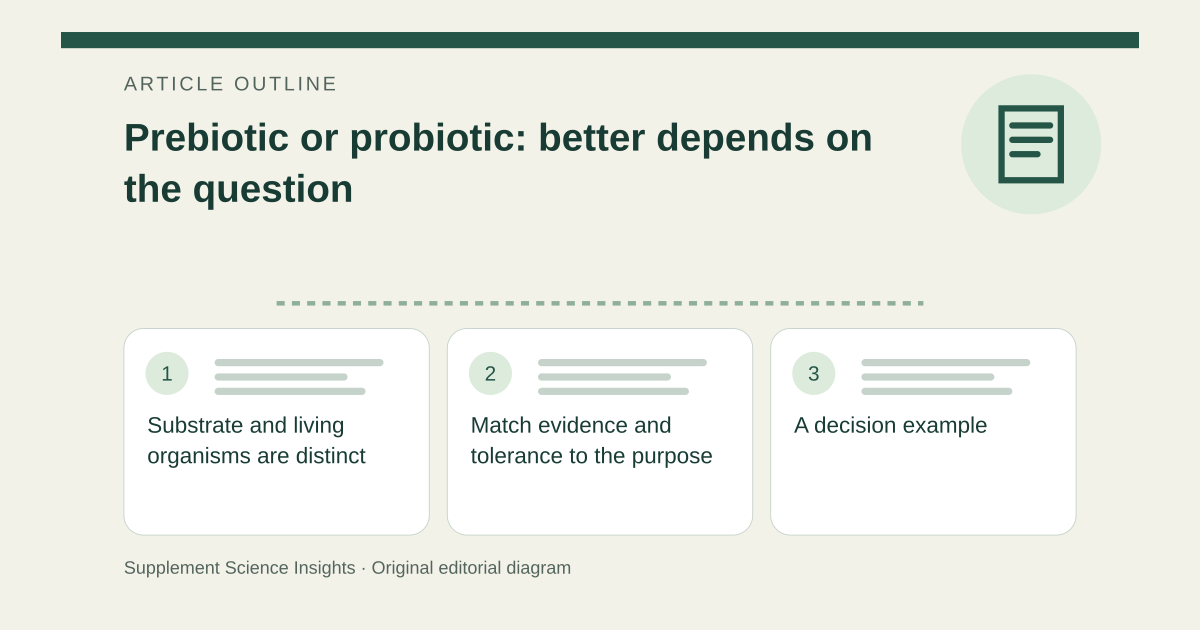
Substrate and living organisms are distinct
Prebiotics are substrates selectively used by host microorganisms that confer a health benefit, while probiotics are live microorganisms with evidence of benefit at an adequate amount. Adding a substrate is not the same as delivering a strain. A product can combine the concepts, but that does not automatically make it more effective. [1]
Match evidence and tolerance to the purpose
The relevant comparison could concern stool frequency, a specific clinical setting or dietary intake. Those are different outcomes, and a broad gut-health promise does not identify the best approach. Particular ingredients, amounts and the person’s health context matter more than the category name. [1]
A decision example
Imagine one product supplies a fermentable ingredient and another supplies a defined bacterial strain. Compare each against the actual goal and evidence, rather than assuming both reset the gut in the same way. If symptoms persist, a diagnosis and dietary assessment can be more useful than alternating categories without a clear plan. [2][1]
| Example | Interpretation |
|---|---|
| Prebiotic | Microbial substrate |
| Probiotic | Defined live organism intervention |
| Combination | Needs its own evidence and tolerability review |
Sources for this article
- Probiotics - Health Professional Fact Sheet
Source consulted: 2026-09-20. This is a reference resource, not a claim that we conducted the studies or tested a product. - Probiotics: Usefulness and Safety | NCCIH
Source consulted: 2026-09-20. This is a reference resource, not a claim that we conducted the studies or tested a product.