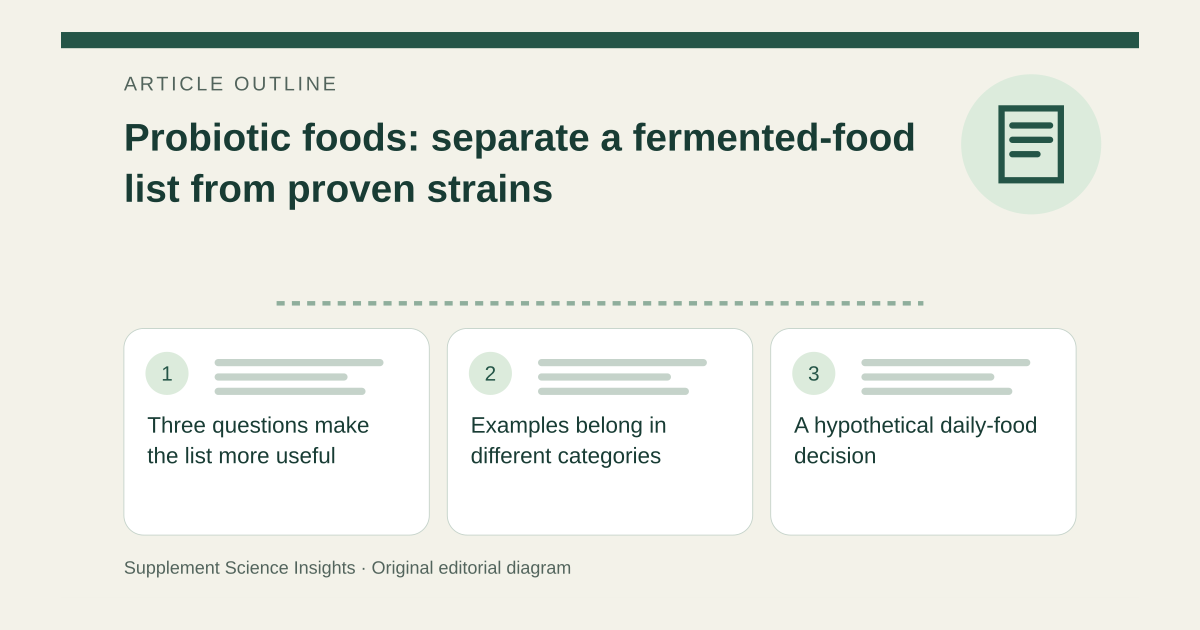
Three questions make the list more useful
First ask whether the food was fermented. Next ask whether live cultures remain when it is eaten. Finally ask whether identified organisms have a demonstrated benefit at the amount supplied. ODS makes these distinctions because a fermented food can fail the second or third test without ceasing to be a food. [1]
Examples belong in different categories
Yogurt has characteristic starter organisms and may contain additional probiotic strains. Kimchi, sauerkraut, miso and many cheeses may contain live microbes without a proven probiotic claim. Sourdough bread and many commercial pickles are examples ODS gives of fermented foods that do not contain live cultures after processing. Unfermented foods can also have probiotics added. [1]
A hypothetical daily-food decision
Imagine someone wants more dietary variety but has no condition-specific probiotic recommendation. A fermented food can be chosen as food without promising a gut reset or guaranteed symptom relief. For a particular health claim, compare the exact strain and amount with relevant evidence; being natural does not answer that question. [1]
| Question | Information needed |
|---|---|
| Was it fermented? | Production process |
| Are cultures alive? | Finished-product treatment and storage |
| Is it a demonstrated probiotic? | Organism,amount and health evidence |
Sources for this article
- Probiotics - Health Professional Fact Sheet
Source consulted: 2026-09-20. This is a reference resource, not a claim that we conducted the studies or tested a product.