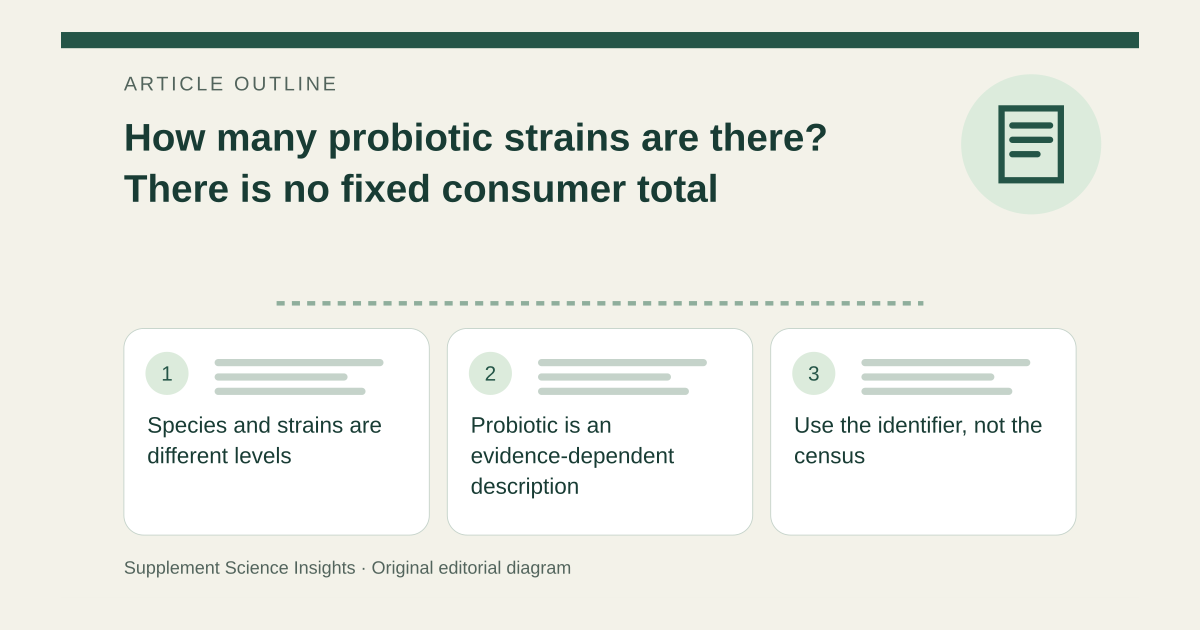
Species and strains are different levels
ODS identifies probiotics by genus, species and strain designation, sometimes including a subspecies. Several strains can belong to one species, and their properties may differ. A familiar species name does not tell you how many characterized strains exist or which one a product contains. [1]
Probiotic is an evidence-dependent description
The term requires live microorganisms supplied in an adequate amount with a demonstrated benefit. A newly identified organism is not automatically a clinically useful probiotic, and evidence for one outcome does not establish every other outcome. The number changes with research and the definition used, so a single timeless total would mislead. [1]
Use the identifier, not the census
Imagine a label lists ten species but omits strain designations. That may look comprehensive while making it hard to match a study. The useful question is whether the exact organisms and combination have evidence for the intended purpose, not whether the package represents a large fraction of all possible strains. [1]
| Example | Interpretation |
|---|---|
| Species name | Not necessarily the full identity |
| Strain designation | More specific lineage |
| Number of label entries | Not a clinical evidence score |
Sources for this article
- Probiotics - Health Professional Fact Sheet
Source consulted: 2026-09-20. This is a reference resource, not a claim that we conducted the studies or tested a product.