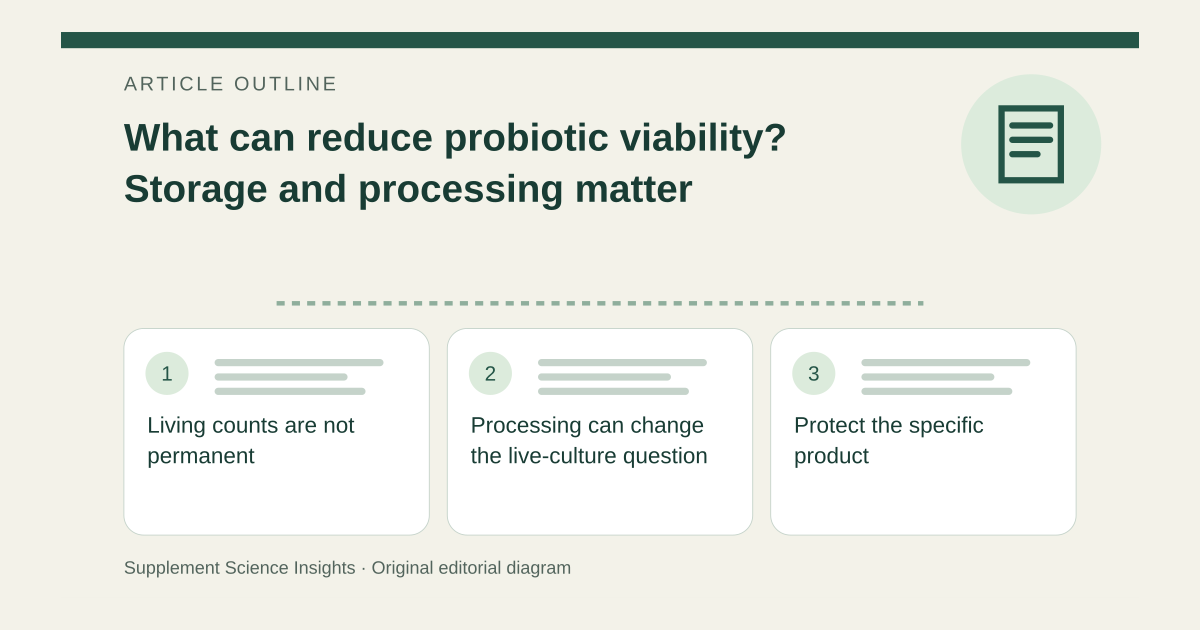
Living counts are not permanent
ODS distinguishes viable colony-forming units through the expiry date from counts at manufacture. That distinction matters because viability can decline over time. Different strains and preparations are not equally stable, so the front-label number is incomplete without date and storage context. [1]
Processing can change the live-culture question
A food can remain fermented after processing that removes or kills the fermentation microbes. The ISAPP consensus distinguishes the history of fermentation from the presence of live organisms at consumption. Cooking a fermented ingredient therefore does not automatically preserve the live-culture exposure implied by a fresh-food claim. [2]
Protect the specific product
Imagine a probiotic powder is left open in an unsuitable environment and later mixed into a hot dish. There is no reliable way to infer the remaining count by appearance. Follow package handling and mixing directions, keep the original storage information, and ask the manufacturer about departures rather than estimating a compensating extra dose. [1]
| Example | Interpretation |
|---|---|
| Manufacture date count | Not a permanent guarantee |
| Heat-treated fermented food | May lack live microbes |
| Unknown storage exposure | Do not guess a replacement dose |
Sources for this article
- Probiotics - Health Professional Fact Sheet
Source consulted: 2026-09-20. This is a reference resource, not a claim that we conducted the studies or tested a product. - The International Scientific Association for Probiotics and Prebiotics (ISAPP) consensus statement on fermented foods | Nature Reviews Gastroenterology & Hepatology
Source consulted: 2026-09-20. This is a reference resource, not a claim that we conducted the studies or tested a product.