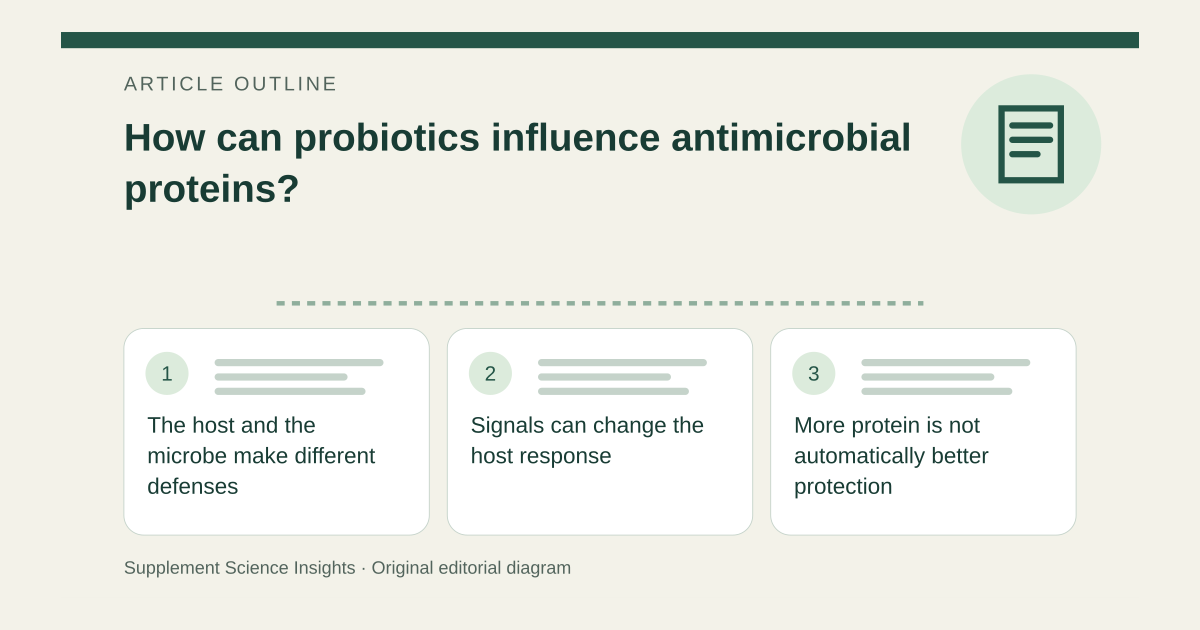
The host and the microbe make different defenses
Intestinal cells produce antimicrobial molecules including defensins, lysozyme and Reg-family proteins. Some bacteria produce bacteriocins that inhibit competing organisms. A supplement claim about antimicrobial proteins should specify whose protein is being measured rather than treating these processes as interchangeable. [1]
Signals can change the host response
The reviewed mechanistic literature describes microbial recognition by host receptors and signaling from microbial metabolites. These pathways can alter expression or release of antimicrobial molecules. Much of the causal work uses cells or animals; the response depends on the organism, tissue and experimental conditions. [1]
More protein is not automatically better protection
Antimicrobial molecules also influence which microbes inhabit a site, and their regulation is complex. A change in gene expression, peptide concentration or laboratory killing activity is not equivalent to fewer infections in people. Human benefits require an appropriate clinical outcome with the actual strain and preparation. [1][2]
Read the endpoint behind the claim
Imagine a capsule advertisement cites increased defensin expression in cultured cells. That supports a mechanism worth studying, not a prescription for an infection. Look for human clinical evidence and do not replace antimicrobial treatment with a mechanistic supplement claim. [1][3]
| Observation | What it establishes |
|---|---|
| Bacteriocin production | Microbial antimicrobial activity |
| Host protein expression | A biological response |
| Animal protection | Preclinical evidence |
| Human infection outcome | The relevant clinical test |
Sources for this article
- Interplay between gut microbiota and antimicrobial peptides - PMC
Source consulted: 2026-09-21. This is a reference resource, not a claim that we conducted the studies or tested a product. - Probiotics - Health Professional Fact Sheet
Source consulted: 2026-09-21. This is a reference resource, not a claim that we conducted the studies or tested a product. - Probiotics: Usefulness and Safety | NCCIH
Source consulted: 2026-09-21. This is a reference resource, not a claim that we conducted the studies or tested a product.