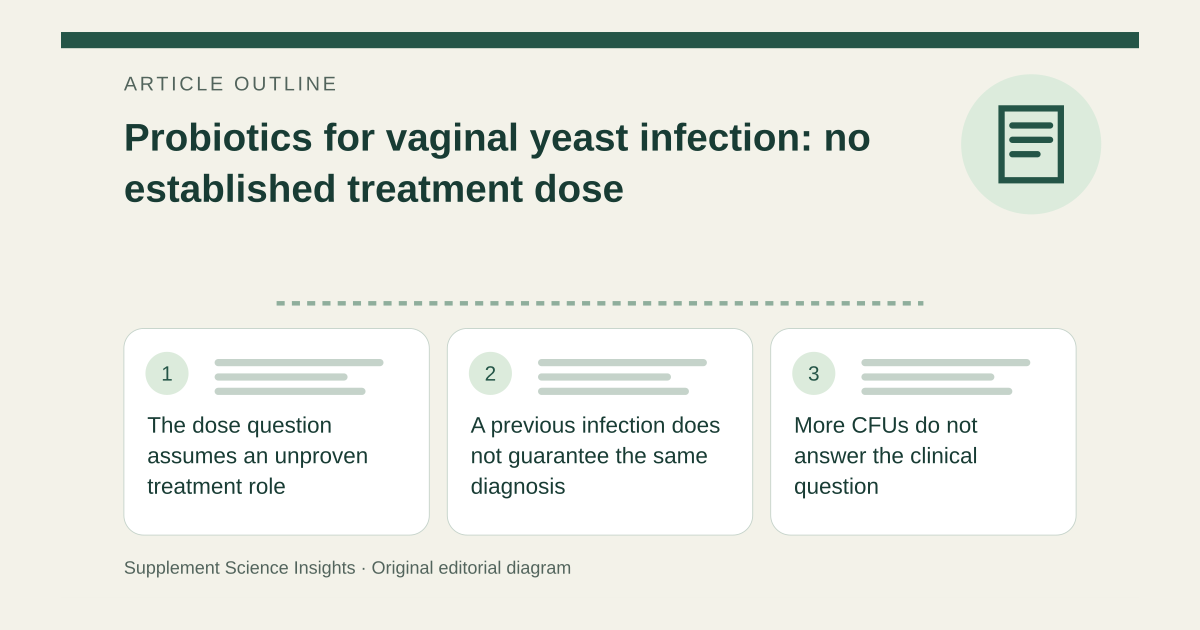
The dose question assumes an unproven treatment role
CDC states that substantial evidence does not support probiotics for treating vaginal yeast infection. Without an established treatment role, a recommendation for a particular number of CFUs or weeks of use would imply more certainty than the guidance provides. [1]
This is a question about vulvovaginal candidiasis. It should not be expanded into claims about eliminating Candida everywhere in the body or treating other forms of fungal disease. [1]
A previous infection does not guarantee the same diagnosis
CDC notes that even people previously diagnosed with vaginal candidiasis may not accurately identify a later episode themselves. Persistent symptoms or recurrence after treatment should be evaluated. [1]
Using an unproven product can delay treatment of another cause of irritation or discharge. A probiotic marketed for vaginal balance is not evidence that the current symptoms are a yeast infection. [1]
More CFUs do not answer the clinical question
Imagine symptoms persist despite a probiotic. Doubling its culture count does not establish the diagnosis or create evidence of antifungal efficacy. The unresolved symptoms are a reason to seek assessment.
| Detail | Interpretation |
|---|---|
| CFU amount | Not an antifungal dose |
| Persistent symptoms | Need evaluation |
| Vaginal candidiasis | A specific diagnosis |
Sources for this article
- Vulvovaginal Candidiasis - STI Treatment Guidelines
Source consulted: 2026-09-17. This is a reference resource, not a claim that we conducted the studies or tested a product.