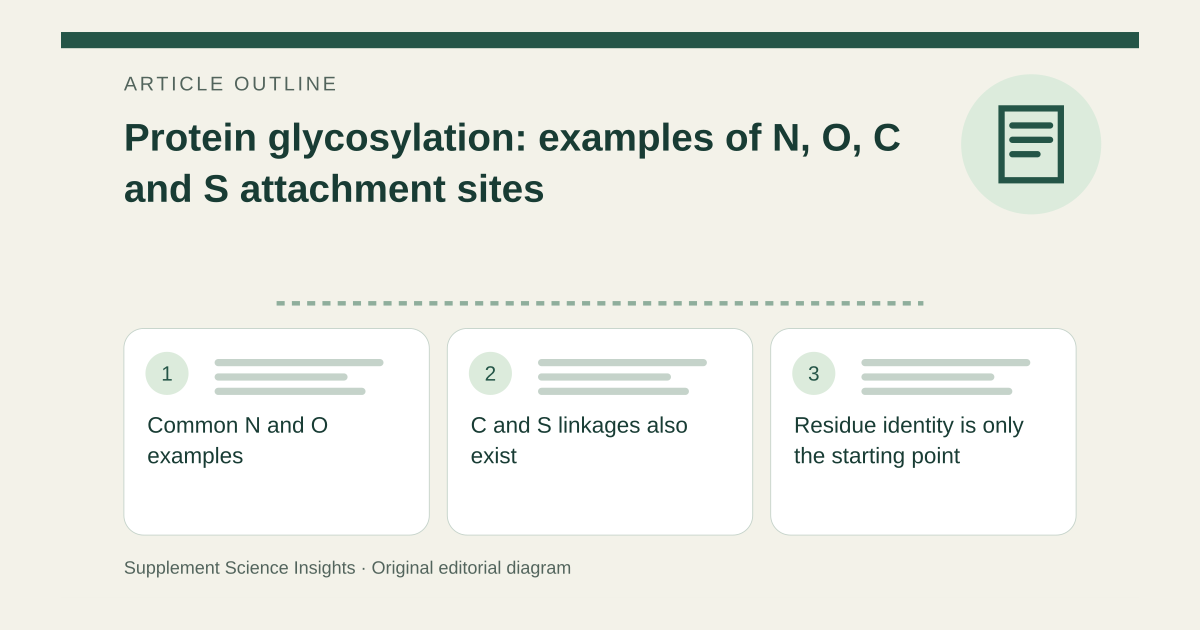
Common N and O examples
N-linked glycans commonly attach to the side-chain nitrogen of asparagine. Serine and threonine provide side-chain oxygen attachment sites for common forms of O-linked glycosylation. [1]
These are examples of linkage chemistry, not an exhaustive list of all glycosylation systems or a guarantee that a particular site is modified. [1]
C and S linkages also exist
A primary study identified a sugar attached through a carbon-carbon bond to tryptophan in human RNase Us. This is a C-linked example. [2][3]
S-glycosylation can attach carbohydrate through cysteine sulfur. The cited detection study used chemically modified model polypeptides; it should not be read as a survey proving how common that modification is in people. [2][3]
Residue identity is only the starting point
Imagine a protein sequence contains asparagine, serine, tryptophan and cysteine. That list identifies possible chemical contexts, but direct site evidence is still needed to claim modification.
| Detail | Interpretation |
|---|---|
| N linkage | Asparagine example |
| O linkage | Serine or threonine examples |
| C / S linkage | Tryptophan / cysteine examples |
Sources for this article
- Protein Folding and Processing - The Cell - NCBI Bookshelf
Source consulted: 2026-09-18. This is a reference resource, not a claim that we conducted the studies or tested a product. - New type of linkage between a carbohydrate and a protein: C-glycosylation of a specific tryptophan residue in human RNase Us - PubMed
Source consulted: 2026-09-18. This is a reference resource, not a claim that we conducted the studies or tested a product. - Protein cysteine S-glycosylation: oxidative hydrolysis of protein S-glycosidic bonds in aqueous alkaline environments - PubMed
Source consulted: 2026-09-18. This is a reference resource, not a claim that we conducted the studies or tested a product.