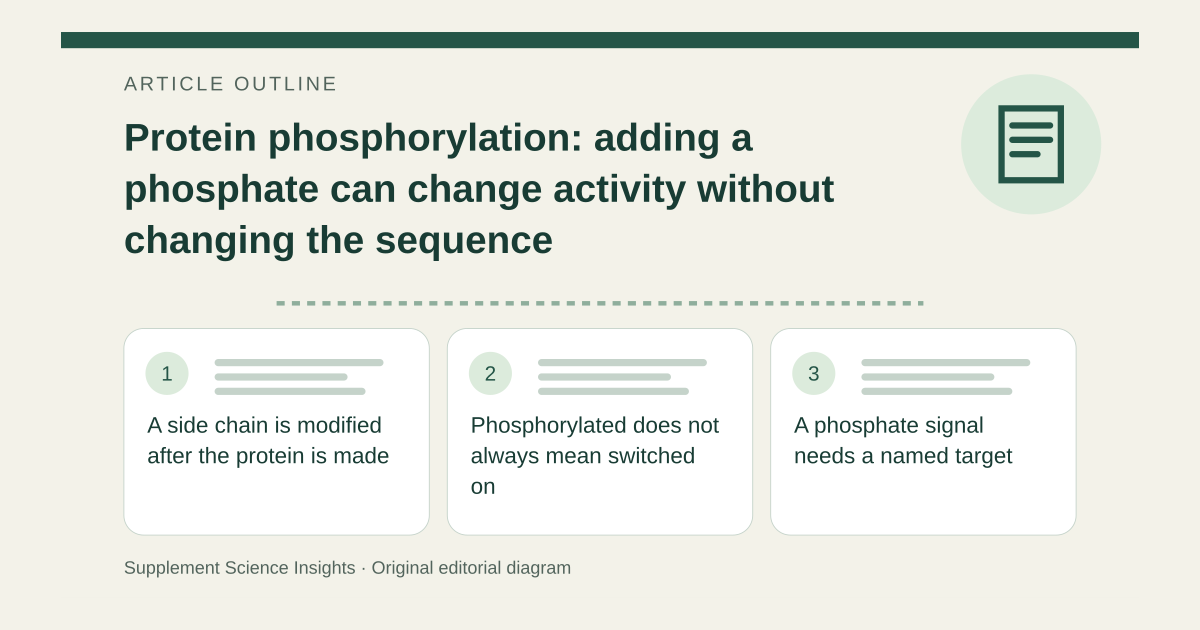
A side chain is modified after the protein is made
Protein kinases commonly transfer phosphate from ATP to a hydroxyl-containing side chain, particularly serine, threonine or tyrosine. This changes the chemical state of a residue without replacing its encoded identity with a different amino acid. [1]
Protein phosphatases reverse many of these modifications. The balance between adding and removing phosphate allows cells to regulate proteins in response to signals. This is one form of post-translational modification, meaning a change after translation. [1]
Phosphorylated does not always mean switched on
Phosphorylation can activate or inhibit a protein, or change interactions within a signaling pathway. The result depends on the target and position. A measurement showing more phosphorylation therefore needs the identity of the site and protein before its biological meaning can be interpreted. [1]
The common serine/threonine/tyrosine classification is not a claim that these are the only possible phosphorylated residues in all organisms or chemical settings. Nor does eating more of these amino acids instruct a particular kinase to modify a chosen target. [1]
A phosphate signal needs a named target
Imagine two proteins are phosphorylated but one becomes more active and the other less active. A report that phosphorylation increased would conceal the difference. Naming the protein, site and measured functional effect makes the result interpretable.
| Description | Interpretation |
|---|---|
| Kinase action | Adds a phosphate group |
| Phosphatase action | Removes a phosphate group |
| Functional consequence | Depends on the target and site |
Sources for this article
- The Cell, 2nd edition: Regulation of Protein Function
Source consulted: 2026-09-17. This is a reference resource, not a claim that we conducted the studies or tested a product.