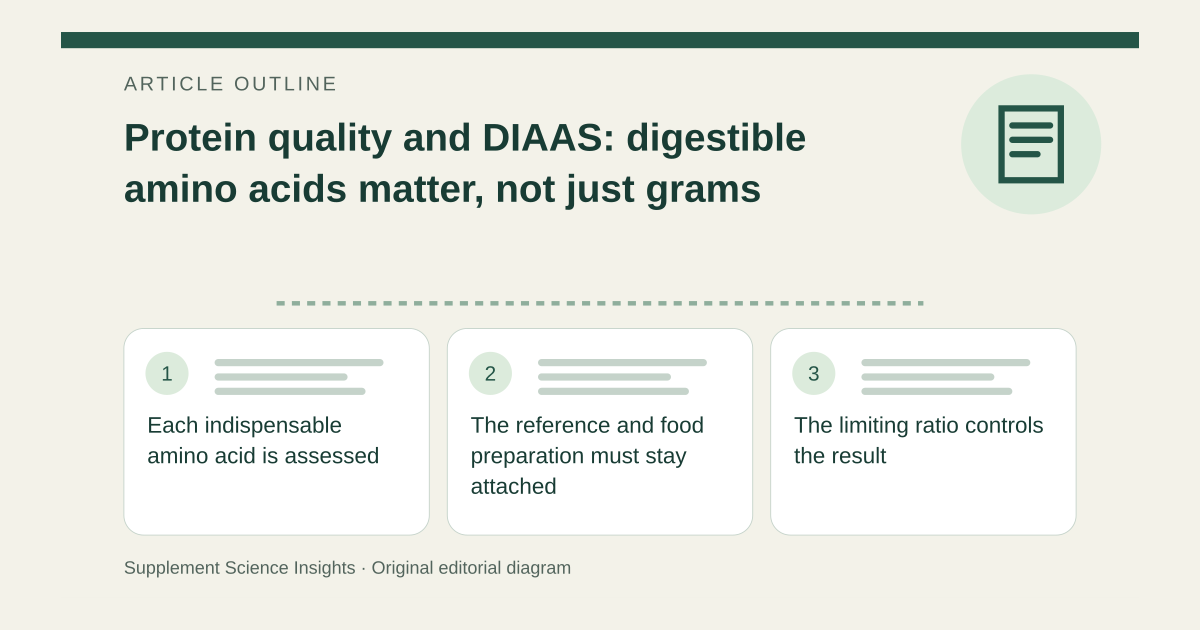
Each indispensable amino acid is assessed
The FAO report recommends evaluating the amount of each digestible indispensable amino acid per gram of protein against the corresponding reference amount. The lowest ratio determines the score. A protein can contain every essential amino acid yet have one present in a limiting proportion. [1]
Digestibility is part of the method. FAO favors assessment at the end of the small intestine rather than relying only on fecal protein measurements, because the individual amino acids and their availability matter. [1]
The reference and food preparation must stay attached
Different reference patterns address different ages. Processing can also affect amino-acid availability, so a score for an ingredient should not be assigned automatically to every food or blend bearing a similar name. [1]
DIAAS does not by itself assess allergy suitability, price, environmental effects, clinical outcomes or the complete diet. It also cannot be calculated from a nutrition label that gives only total protein grams without the needed amino-acid and digestibility data. [1]
The limiting ratio controls the result
Imagine two proteins provide equal grams but differ in the available amount of an indispensable amino acid. Equal protein mass alone does not establish an equal quality score. The missing composition and digestibility data are essential.
| Detail | Interpretation |
|---|---|
| Protein grams | Total quantity |
| Digestible amino-acid pattern | Quality calculation input |
| Lowest reference ratio | Determines DIAAS |
Sources for this article
- FAO: Dietary protein quality evaluation in human nutrition
Source consulted: 2026-09-17. This is a reference resource, not a claim that we conducted the studies or tested a product.