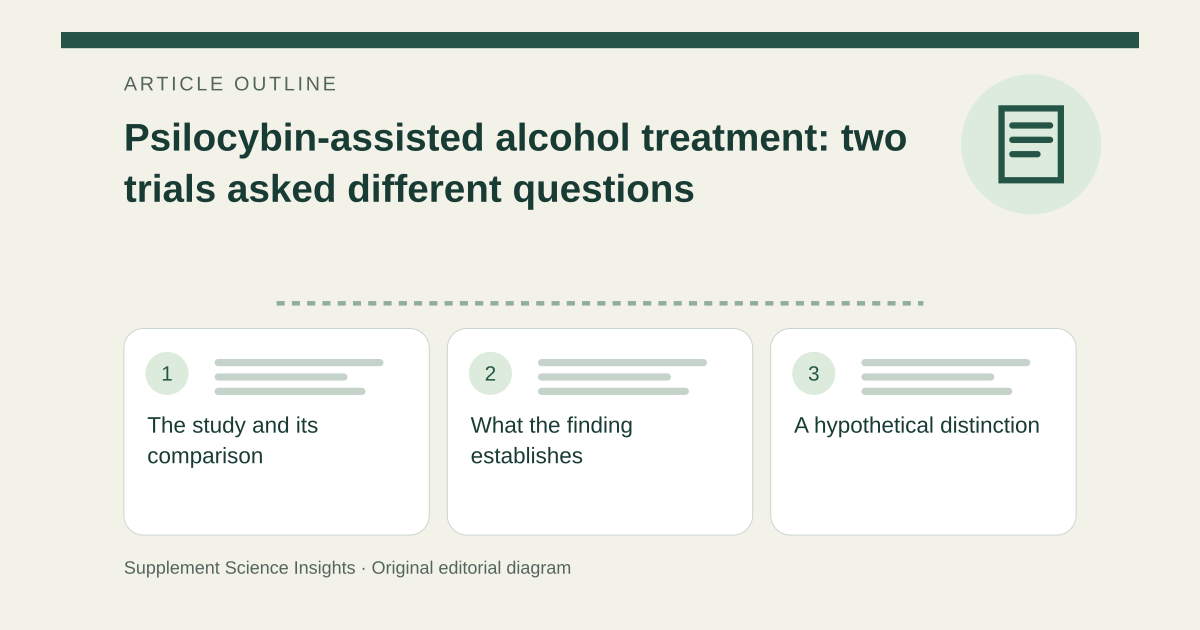
The study and its comparison
A 2022 trial randomized 95 adults to supervised psilocybin or diphenhydramine sessions with psychotherapy; 93 entered the primary analysis. Heavy-drinking days averaged 9.7 percent versus 23.6 percent over 32 weeks. [1][2]
A 2025 Swiss study analyzed 37 participants after withdrawal treatment. One supervised session plus brief psychotherapy did not significantly improve abstinence or alcohol consumption compared with placebo. [1][2]
What the finding establishes
Different populations, session counts and psychotherapy prevent a simple contradiction or universal promise. Funding included Heffter and private donors in the first study and Swiss and foundation support in the second; industry relationships were disclosed. These studies do not establish unsupervised mushroom use as treatment. [1][2]
A hypothetical distinction
Imagine reduced heavy-drinking days in one setting but no relapse benefit in another. Retain both populations and endpoints.
| Detail | Interpretation |
|---|---|
| Measured outcome | Keep the endpoint specific |
| Study preparation | Not every retail product |
| Remaining uncertainty | Not resolved by a mechanism |
Sources for this article
- Percentage of Heavy Drinking Days Following Psilocybin-Assisted Psychotherapy vs Placebo in the Treatment of Adult Patients With Alcohol Use Disorder: A Randomized Clinical Trial.
Source consulted: 2026-09-19. This is a reference resource, not a claim that we conducted the studies or tested a product. - Psilocybin-assisted therapy for relapse prevention in alcohol use disorder: a phase 2 randomized clinical trial.
Source consulted: 2026-09-19. This is a reference resource, not a claim that we conducted the studies or tested a product.