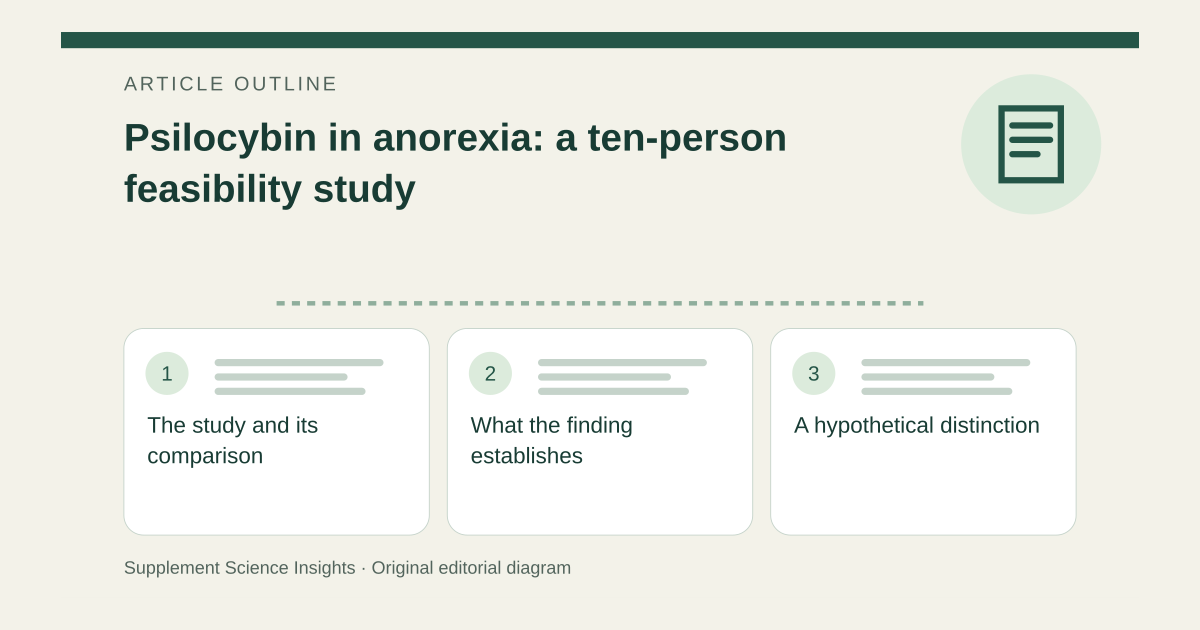
The study and its comparison
Ten adult women with anorexia nervosa or partial remission received one supervised synthetic-psilocybin session with psychological support in an open-label study. [1]
Reported adverse effects were mild and transient. Two participants developed asymptomatic low blood sugar after treatment, resolving within 24 hours. ECG, vital-sign and suicidality assessments showed no clinically significant changes. [1]
What the finding establishes
Without a control group, a ten-person safety study cannot establish efficacy or exclude uncommon harms. Compass Pathways funded the work, and two investigators disclosed paid company roles. The findings do not justify using mushrooms to alter appetite or replacing established eating-disorder care. [1]
A hypothetical distinction
Imagine participants complete a procedure acceptably. Feasibility is a different endpoint from recovery.
| Detail | Interpretation |
|---|---|
| Measured outcome | Keep the endpoint specific |
| Study preparation | Not every retail product |
| Remaining uncertainty | Not resolved by a mechanism |
Sources for this article
- Psilocybin therapy for females with anorexia nervosa: a phase 1, open-label feasibility study.
Source consulted: 2026-09-19. This is a reference resource, not a claim that we conducted the studies or tested a product.