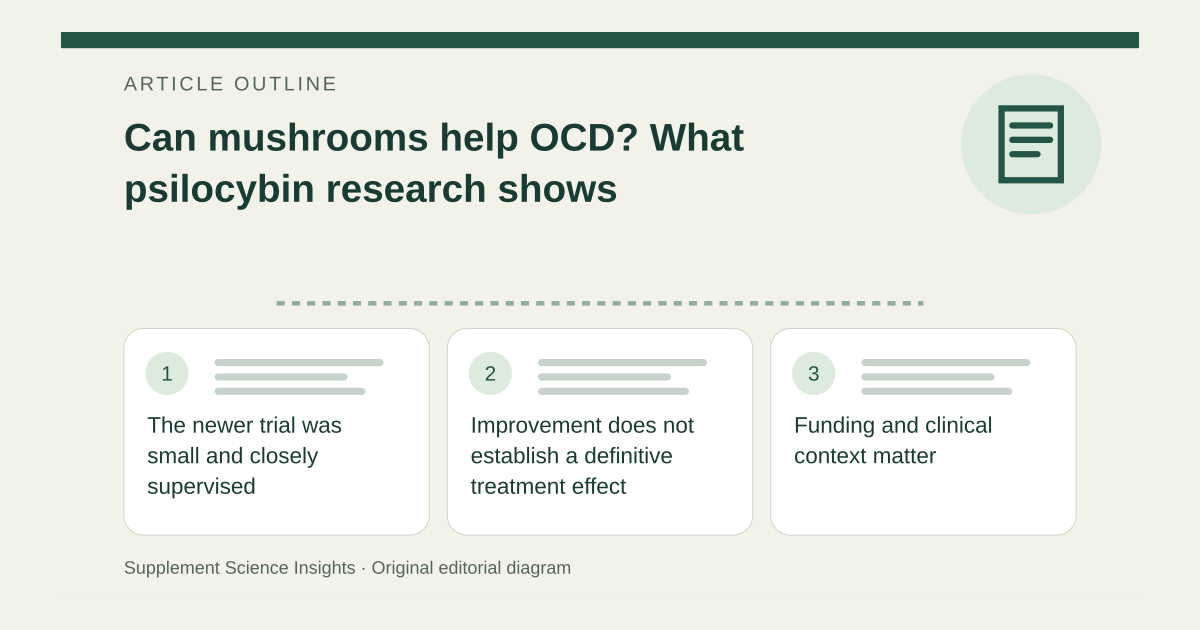
The newer trial was small and closely supervised
Fifteen adults with moderate-to-severe OCD were randomized to one of two psilocybin conditions or lorazepam, five per group, during four weekly sessions. A later four-week phase provided high-dose psilocybin to all continuing participants; 14 completed that phase. [1]
Improvement does not establish a definitive treatment effect
The study reported symptom reductions. However, it was not powered adequately for between-group comparisons, and the later phase lacked a continuing control condition. Small numbers, expectancy, selected participants and naturalistic follow-up limit conclusions. No serious adverse events in this sample does not establish rare-event safety. [1]
Funding and clinical context matter
Usona supplied the psilocybin without charge; one author disclosed LivaNova monitoring-board honoraria. Participants underwent screening and clinical monitoring. Their medication changes were managed within the study and are not instructions for readers to stop treatment. [1]
Discuss research alongside established care
Imagine someone with persistent OCD sees a claim that mushrooms cure compulsions. The trial cannot support that promise. NIMH describes established approaches including psychotherapy and medication; discuss appropriate care or legitimate research participation with an OCD clinician. [2]
| Study feature | Interpretation |
|---|---|
| 15 randomized adults | Small selected sample |
| Later all-active phase | No continuing placebo comparison |
| Symptom improvement | Not proof of a cure |
| Supervised medication changes | Not a home taper plan |
Sources for this article
- A randomized clinical trial of repeated doses of psilocybin for the treatment of obsessive–compulsive disorder - PMC
Source consulted: 2026-09-21. This is a reference resource, not a claim that we conducted the studies or tested a product. - Obsessive-Compulsive Disorder (OCD) - National Institute of Mental Health (NIMH)
Source consulted: 2026-09-21. This is a reference resource, not a claim that we conducted the studies or tested a product.