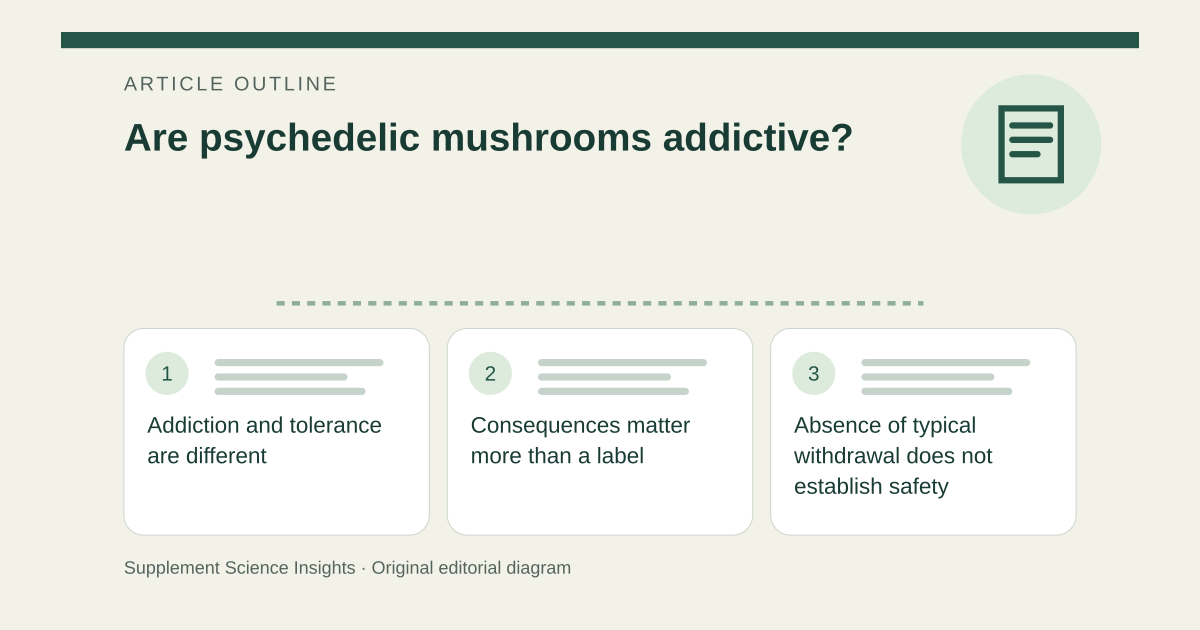
Addiction and tolerance are different
NIDA reports limited evidence that classic psychedelics usually lead to addiction, while also noting rapid tolerance. Tolerance means a changed response after exposure; it is not by itself proof of addiction and is not a reason to increase the amount. [1]
Consequences matter more than a label
Continued use despite harm to health, relationships, work or safety can still merit assessment. Diagnostic frameworks include other hallucinogen use disorder even though not every psychedelic has its own named diagnosis. [1]
Absence of typical withdrawal does not establish safety
Someone can experience panic, persistent perceptual symptoms or other complications without physical dependence. Different psychoactive products also have different risks; ketamine findings should not be treated as psilocybin findings. [1]
Seek help when use is becoming difficult to control
Imagine a person repeatedly uses mushrooms despite worsening anxiety and missed responsibilities. They do not need to prove a particular withdrawal syndrome before asking for support. Discuss the pattern honestly with a health professional. [1][2]
| Pattern | Meaning |
|---|---|
| Weaker effects after repeated use | Tolerance |
| Continued use despite harm | Reason for clinical assessment |
| No physical withdrawal | Does not rule out problems |
| Low typical reinforcement | Not a guarantee for an individual |
Sources for this article
- Psychedelic and Dissociative Drugs | National Institute on Drug Abuse (NIDA)
Source consulted: 2026-09-21. This is a reference resource, not a claim that we conducted the studies or tested a product. - Psilocybin for Mental Health and Addiction: What You Need To Know | NCCIH
Source consulted: 2026-09-21. This is a reference resource, not a claim that we conducted the studies or tested a product.