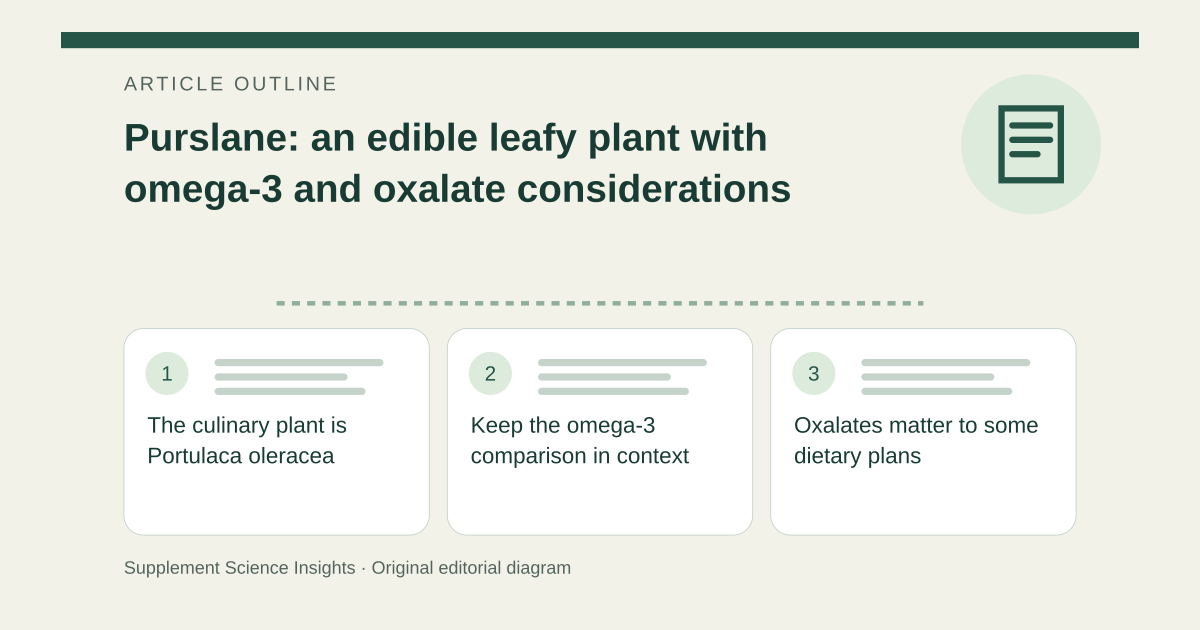
The culinary plant is Portulaca oleracea
NC State describes edible leaves, stems and flowers with a tart, slightly salty taste. They can be used in salads or cooked dishes, and their mucilaginous texture can thicken soups. Use correctly identified, food-grade produce rather than assuming a roadside weed is suitable. [1]
Keep the omega-3 comparison in context
Plant omega-3 nutrition is not interchangeable with the EPA and DHA supplied by fish oil. ODS distinguishes ALA from these longer-chain fats and notes limited conversion. A serving of purslane should not be treated as an equivalent dose of a fish-oil capsule. [2][1]
Oxalates matter to some dietary plans
NC State notes purslane’s oxalate content. If you have been advised to limit oxalate, check how it fits your plan instead of consuming large amounts for a nutrient claim. Imagine adding a modest amount to soup: that is a food choice, not a treatment regimen or a reason to ignore an individualized diet. [1]
| Item | Interpretation |
|---|---|
| Food-grade purslane | A culinary vegetable |
| Plant omega-3 | Not an EPA/DHA dose match |
| Oxalate restriction | Needs individual dietary context |
Sources for this article
- Portulaca oleracea (Common Purslane, Garden Purslane, Little Hogweed, Little Hog Weed, Moss Rose, Pigwee, Pigweed, Portulaca, Purselane, Purslane, Pusley, Red Root, Rock Moss, Rose Moss, Verdolaga, Wild Portulaca) | North Carolina Extension Gardener Plant Toolbox
Source consulted: 2026-09-20. This is a reference resource, not a claim that we conducted the studies or tested a product. - Omega-3 Fatty Acids - Health Professional Fact Sheet
Source consulted: 2026-09-20. This is a reference resource, not a claim that we conducted the studies or tested a product.