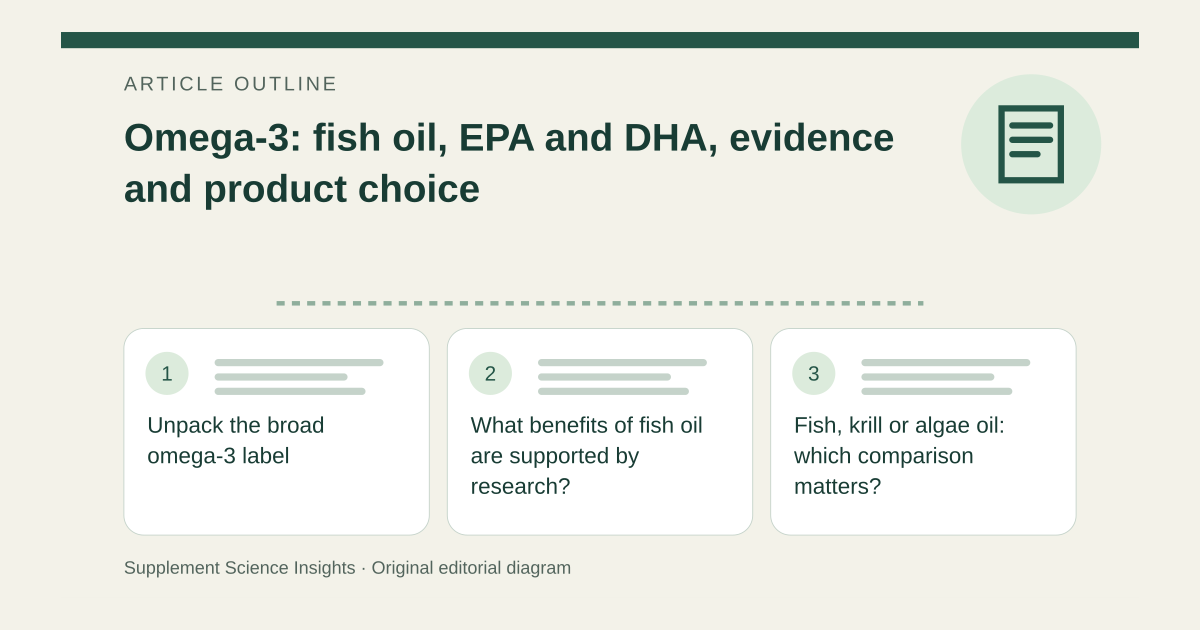
Unpack the broad omega-3 label
Omega-3 describes a group of fatty acids. ALA, EPA and DHA are distinct members. Products can use fish, krill or algal oils, and their declared quantities vary. A source name does not replace the ingredient amounts on the label. [1]
When a claim specifically concerns EPA or DHA, locate those entries. The amount of total oil is a different quantity. Keep the source, serving size and separately declared constituents together when documenting a product. [1]
What benefits of fish oil are supported by research?
Fish oil is not a universal heart-protection supplement. In VITAL, 25,871 adults received a daily capsule containing 460 mg EPA and 380 mg DHA or placebo for a median of 5.3 years. The primary combined outcome of major cardiovascular events was not significantly reduced. A reduction in heart attacks was a secondary finding, so it should not replace the primary result when summarizing the trial. [2]
The trial studied primary prevention in older adults, not treatment of very high triglycerides. Its dose, participants and outcomes differ from prescription omega-3 studies. A product containing fish oil cannot borrow a prescription medicine’s indication merely because both labels mention omega-3. [2]
Fish, krill or algae oil: which comparison matters?
Fish and krill oils can supply EPA and DHA; algal products offer a non-fish source, but some provide DHA without substantial EPA. Check both amounts. Flax and chia supply ALA, which the body converts to EPA and DHA only to a limited extent. Equal milligrams of ALA and EPA plus DHA are not equivalent exposures. [1]
If you already eat fish, begin with your diet and the reason for considering a supplement. Do not assume that adding a capsule recreates the effects associated with a fish-containing dietary pattern. A vegan preference, fish allergy, swallowing difficulty and a medical indication each change the comparison; there is no single best oil for all four. [1]
How to compare fish-oil quality and value
Use the actual EPA-plus-DHA amount per serving, the number of servings and the price available at the time of purchase. A fictional bottle costing $24 for 60 servings of 500 mg EPA plus DHA contains 30 g in total, or $0.80 per gram. This is arithmetic, not a current market price or an intake recommendation. [3]
Look for a testing record that identifies the exact product and, where available, the batch. IFOS publishes results covering omega-3 content, contaminants and oxidation. A program description or brand logo alone is not a passing report for the bottle in your hand. These tests address composition and quality; they do not show that a product prevents disease. [3]
Liquid, capsules and freshness: what can be verified?
Compare liquid and capsule products on the same declared EPA-plus-DHA quantity before considering convenience. Record the storage directions and how quickly the container can realistically be used after opening. A larger bottle is poor value if it cannot be stored or used as directed. [3]
An unpleasant or changed smell can prompt a product-quality question, but a smell check cannot quantify oxidation or exclude contaminants. For a stronger answer, seek a current stability result and follow the manufacturer’s storage and expiry information. Do not promote an absorption or freshness claim into proof of better clinical outcomes. [3]
Calculate EPA plus DHA from the stated entries
An invented label declares 1,000 mg total oil, 250 mg EPA and 150 mg DHA per serving. Adding the two stated fatty acids gives 400 mg EPA plus DHA. The total oil number is not a second expression of that same amount.
The remaining 600 mg cannot be fully characterized from these three entries alone. Nor can the arithmetic establish freshness, contaminant levels, clinical benefit or a suitable intake. The numbers describe a fictional teaching label, not a tested product.
| Label field | Per-serving amount |
|---|---|
| Total oil | 1,000 mg |
| EPA | 250 mg |
| DHA | 150 mg |
| EPA plus DHA | 400 mg |
| Clinical benefit | Not established by label arithmetic |
Do not turn a formulation detail into an outcome claim
ODS discusses several oil forms and differences in their absorption. A form description or an absorption result does not by itself establish better cardiovascular outcomes for the person reading a bottle. [1]
Write down the endpoint used to support a claim. If the evidence concerns a blood fatty-acid measurement, do not present it as though the study measured fewer heart attacks. Different questions require different evidence. [1]
Keep prescription trials in their own context
The ODS synthesis discusses differing results across omega-3 trials, including prescription preparations and selected cardiovascular-risk populations. Findings for a specific preparation and study population should not be transferred to every dietary supplement sold as fish oil. [1]
A comparison record should preserve the preparation, participants, background treatment, comparator, follow-up and primary outcome. A similar daily weight alone does not make two interventions equivalent. This article does not independently compare those trials or name a clinical winner. [1]
Check the medicine and health context
Some trials of high-dose omega-3 preparations in people with cardiovascular disease or elevated risk found more atrial fibrillation. That finding should not be converted into the same risk estimate for every product or dose. Anticoagulant use also warrants professional review. [1]
Bring the exact product label and medicine list to a clinician or pharmacist. Do not use this label worksheet to select a high-dose regimen or replace a prescribed product. [1]
How to use this evidence
Use the sections above to match a question with the preparation, population and outcome actually studied. Follow the related reading for more detailed questions; a useful comparison may still end with uncertainty rather than a winning product.
This is an editorial evidence guide, not a systematic review or individual medical advice. No new clinical review credentials, product tests or personal treatment plan are implied. Study protocols and fictional value examples are identified as such.
Sources for this article
- NIH ODS — Omega-3 Fatty Acids: Health Professional Fact Sheet
Source consulted: 2026-09-17. This is a reference resource, not a claim that we conducted the studies or tested a product. - Manson et al. — Marine Omega-3 Fatty Acids and Prevention of Vascular Disease and Cancer (VITAL)
Source consulted: 2026-10-28. This is a reference resource, not a claim that we conducted the studies or tested a product. - Nutrasource — How IFOS certification works
Source consulted: 2026-10-28. This is a reference resource, not a claim that we conducted the studies or tested a product.
Considering a supplement?
Ingredient evidence alone does not establish which retail product is suitable. The featured option illustrates the label and formulation context above; it is not a clinical efficacy ranking.
Compare omega-3 formulations (retail checks pending) → No overall winner
Compare formulations → · How we select products