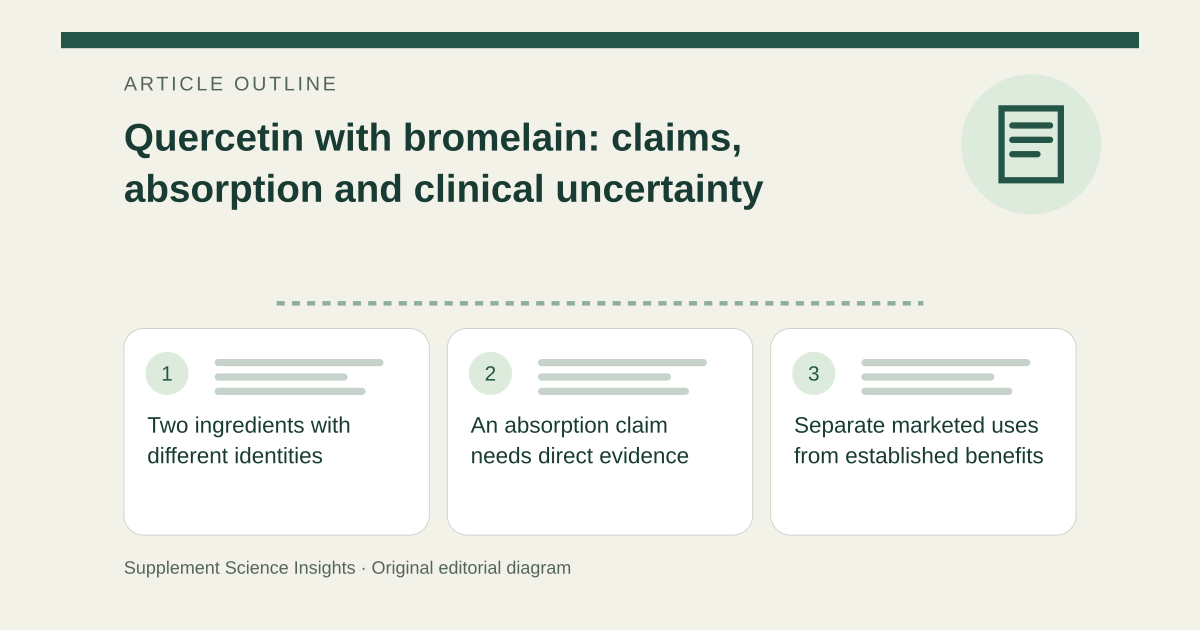
Two ingredients with different identities
Quercetin is a dietary flavonoid found in foods such as onions and apples. Bromelain is a group of protein-breaking enzymes from pineapple. Their different biological properties help explain why they appear together in marketing, but a plausible rationale is not a demonstrated clinical outcome. [1][2]
An absorption claim needs direct evidence
The inspected MSK and NCCIH summaries do not establish a dependable human absorption advantage for the quercetin-bromelain combination. A claim would need a comparison using the actual formulation and relevant exposure measurements. Even a demonstrated change in absorption would still leave the question of symptom benefit and safety. [1][2]
Separate marketed uses from established benefits
NCCIH finds insufficient high-quality evidence to recommend oral bromelain for sinusitis, while some dental-surgery studies suggest symptom benefit. MSK describes mixed human findings for quercetin and substantial preclinical research. Neither summary validates every combined product for allergy, general immune support or chronic inflammation. [2][1]
A blend does not remove ingredient risks
Oral bromelain can cause stomach upset or diarrhea, and pregnancy or breastfeeding safety is poorly known. Quercetin has potential medicine interactions with varying evidence strength; MSK describes a warfarin-associated elevated-INR case and laboratory enzyme findings of uncertain clinical relevance. Review concentrated products with the relevant treatment team. [2][1]
Ask what was actually tested
Imagine an advertisement cites a quercetin experiment but sells quercetin, bromelain and several herbs together. The experiment does not establish the finished blend’s effect. Look for the exact preparation, population and symptom outcome rather than assuming that more components strengthen the evidence. [1][2]
| Claim | Evidence needed |
|---|---|
| Better absorption | Direct formulation comparison in people |
| Less sinus discomfort | Relevant patient symptom outcomes |
| Works as a blend | Evidence for the complete preparation |
| Safe with medicine | Individual interaction review |
Sources for this article
- Quercetin | Memorial Sloan Kettering Cancer Center
Source consulted: 2026-09-21. This is a reference resource, not a claim that we conducted the studies or tested a product. - Bromelain: Usefulness and Safety | NCCIH
Source consulted: 2026-09-21. This is a reference resource, not a claim that we conducted the studies or tested a product.