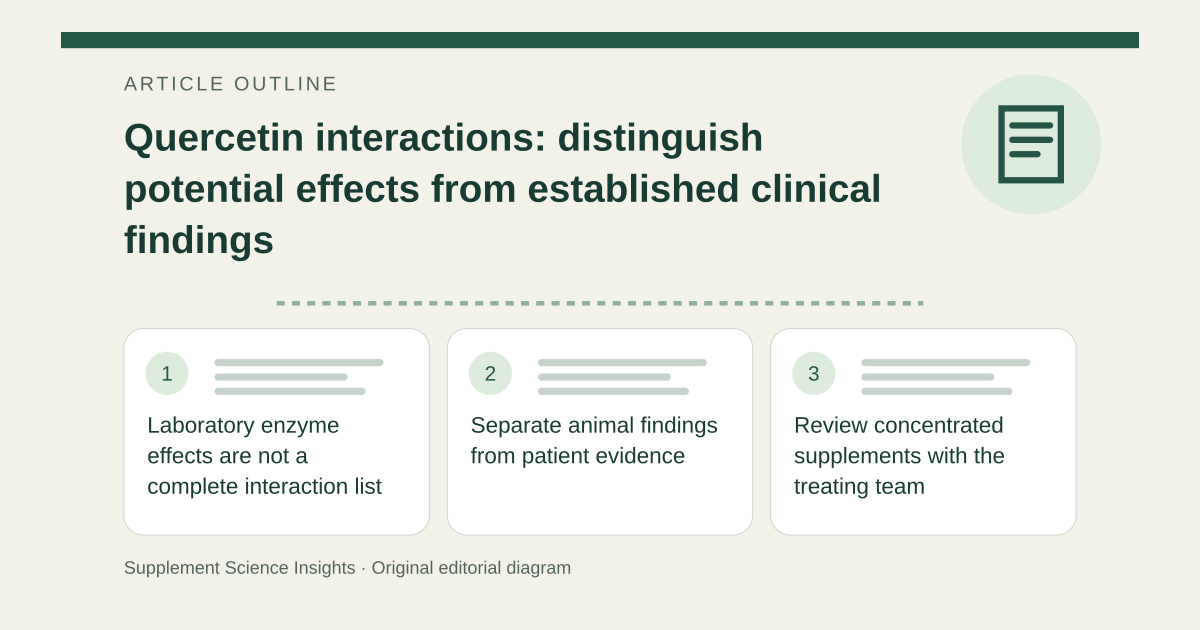
Laboratory enzyme effects are not a complete interaction list
Memorial Sloan Kettering reports inhibition of CYP3A4 and CYP2C19 in laboratory work and states that clinical relevance is unknown. This does not establish that every medicine using those enzymes will produce a harmful interaction at ordinary supplement exposure. It also does not establish safety. [1]
Separate animal findings from patient evidence
MSK describes preclinical findings involving losartan and tamoxifen, with clinical importance undetermined. It also notes a report of elevated INR with quercetin in a warfarin user. A case report is a signal for caution, not a measurement of how often the interaction happens. [1]
Review concentrated supplements with the treating team
Bring the exact quercetin product, amount and other ingredients to the pharmacist, anticoagulation service or oncology team as appropriate. Do not stop prescribed treatment or invent a spacing interval to work around a theoretical mechanism. Food exposure and a concentrated product should not simply be treated as identical. [1][2]
Name what is known and what is uncertain
Imagine an interaction checker flags a drug because of an enzyme pathway. Ask whether the warning comes from patient evidence or a laboratory observation and what action is appropriate for the actual regimen. The flag is a prompt for interpretation, not proof that harm will occur. [1]
| Evidence | What it can establish |
|---|---|
| Laboratory enzyme finding | A possible mechanism |
| Clinical report | A signal requiring context |
| Individual medication review | An appropriate practical plan |
Sources for this article
- Quercetin | Memorial Sloan Kettering Cancer Center
Source consulted: 2026-09-20. This is a reference resource, not a claim that we conducted the studies or tested a product. - Dietary Supplements: What You Need to Know
Source consulted: 2026-09-20. This is a reference resource, not a claim that we conducted the studies or tested a product.