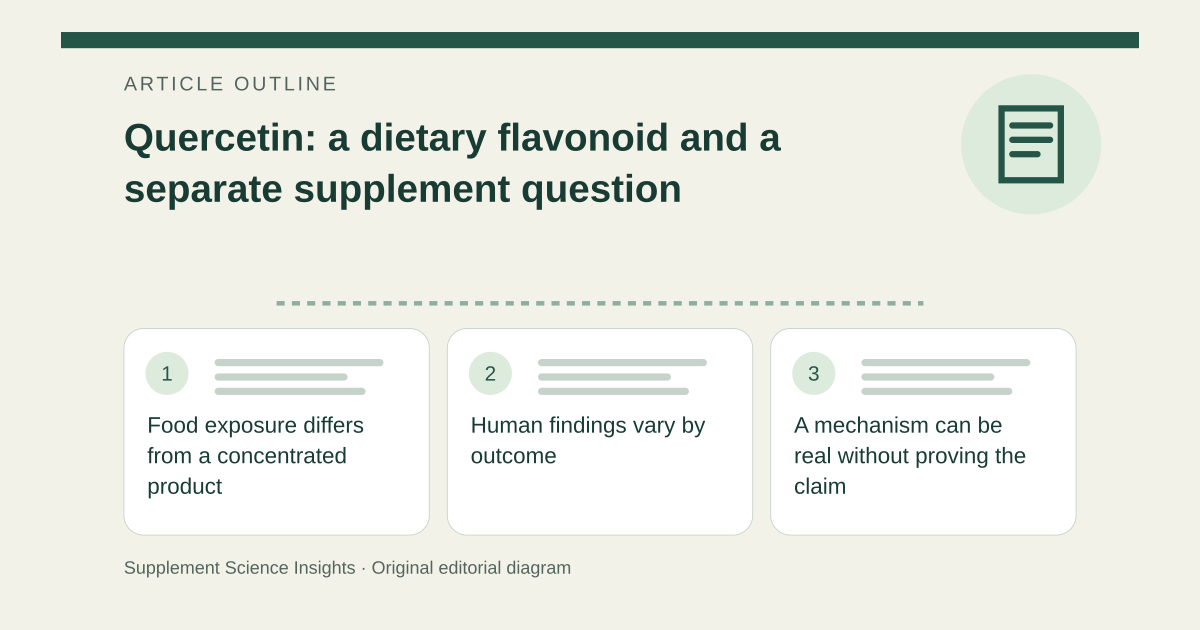
Food exposure differs from a concentrated product
Quercetin is a flavonoid found in foods such as onions, apples and several teas. Supplements can deliver it in concentrated preparations or alongside other ingredients. A dietary source and a capsule should not automatically share one evidence conclusion. [1]
A formulation name may also describe an attempt to alter delivery. That detail requires its own evidence rather than an assumption that the ingredient's printed amount predicts tissue exposure or clinical benefit. [1]
Human findings vary by outcome
Memorial Sloan Kettering describes a mixture of laboratory and human research, with inconsistent findings across metabolic, exercise and other outcomes. Preclinical anti-inflammatory or anticancer activity does not establish treatment or prevention in people. [1]
A study of a quercetin-containing combination cannot isolate quercetin's contribution. The population, preparation and exact endpoint should remain visible rather than being compressed into a universal antioxidant benefit. [1]
A mechanism can be real without proving the claim
A cell experiment may identify a pathway worth investigating. To support a clinical claim, researchers still need to establish relevant exposure in people and measure an outcome that matters. The pathway description alone cannot tell a reader whether a supplement reduces symptoms or improves daily function.
The same distinction applies to an exercise marker. A change in an oxidative-stress measure is not automatically faster recovery, greater strength or fewer injuries. A fair account reports the marker and the practical outcomes separately, including any that did not change.
Potential drug interactions need an accurate evidence label
Laboratory findings suggest effects on some drug-metabolizing enzymes, but their clinical significance is not established. MSK also describes a report of increased INR in a person taking warfarin after starting quercetin. A case report is a signal, not an estimate of how often an interaction occurs. [1]
Review the complete supplement and medicines professionally, particularly during cancer treatment or anticoagulation. This page does not provide a dose adjustment, infer that food amounts carry identical exposure, or treat uncertainty as proof of no interaction. [1]
A combined formula leaves attribution unresolved
Imagine a fictional respiratory-symptom trial tests quercetin together with vitamin C and another ingredient. A favorable result concerns the combination. It does not establish that quercetin alone caused the change or that adding still more improves the result.
An accurate comparison records every active component and the comparator. The example is not a recommendation to assemble a similar blend and does not represent an actual efficacy finding.
| Hypothetical claim basis | Remaining question |
|---|---|
| Three-ingredient trial | Which component contributed? |
| Antioxidant marker changed | Did a meaningful outcome improve? |
| Concentrated capsule | Does food evidence apply? |
Ask for the human endpoint behind the mechanism
This overview does not recommend quercetin for allergy, cancer or immune treatment. A useful supplement claim identifies what changed in people using the exact preparation, while preserving negative findings and interaction uncertainty. A dietary association or laboratory mechanism cannot supply that missing clinical evidence.
Sources for this article
- Memorial Sloan Kettering — Quercetin
Source consulted: 2026-09-17. This is a reference resource, not a claim that we conducted the studies or tested a product.