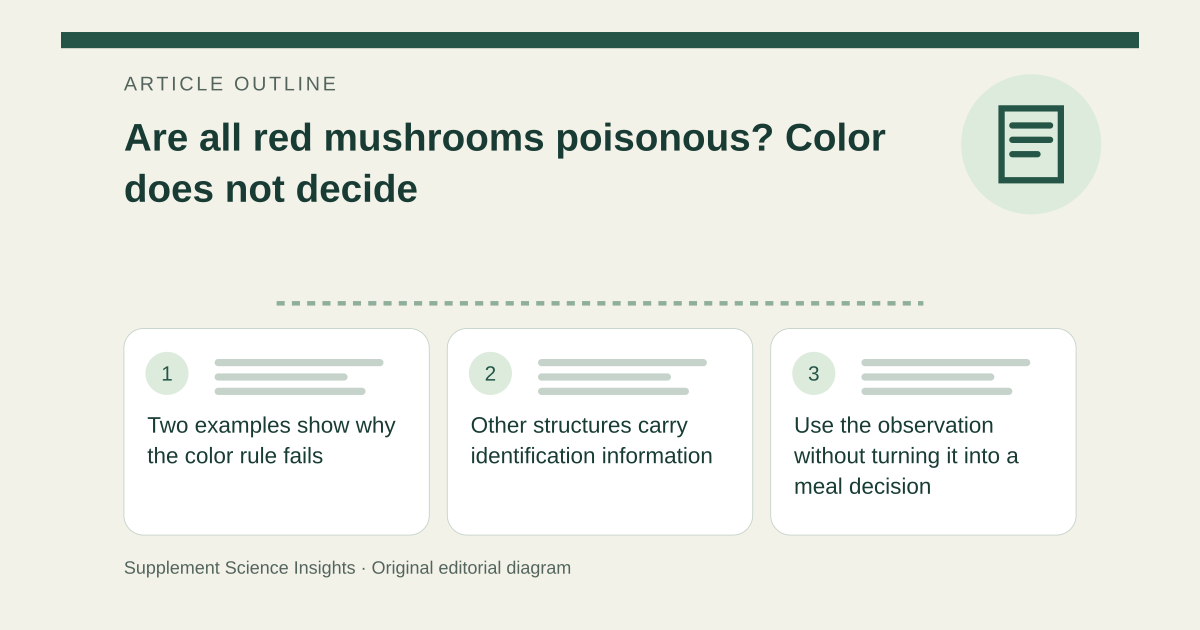
Two examples show why the color rule fails
Missouri’s conservation guide classifies the reddish-orange cinnabar chanterelle, Cantharellus cinnabarinus, as edible when properly identified. Woodland Trust describes red- or orange-capped fly agaric, Amanita muscaria, as poisonous. Similar broad colors therefore occur in fungi with very different eating-safety profiles. [1][2]
Other structures carry identification information
The cinnabar chanterelle has ridges below its cap rather than true gills. Fly agaric has gills, and its white cap spots can wash away. These examples illustrate why a single color or missing spot cannot establish a species. They are not a complete identification key or permission to eat a found specimen. [1][2]
Use the observation without turning it into a meal decision
Imagine seeing a small red fungus and finding a similar photograph online. Record its location and appearance for an expert, but keep it out of food until its identity is established. If an unidentified wild mushroom may have been swallowed, call US Poison Help at 1-800-222-1222 immediately rather than waiting for symptoms. [3]
| Observation | What it does not establish |
|---|---|
| Red or orange cap | Edibility |
| No white spots | Exclusion of a poisonous species |
| Similar online photograph | Confirmed specimen identity |
Sources for this article
- Missouri Department of Conservation: Cinnabar Chanterelle
Source consulted: 2026-09-20. This is a reference resource, not a claim that we conducted the studies or tested a product. - Fly Agaric (Amanita muscaria) - Woodland Trust
Source consulted: 2026-09-20. This is a reference resource, not a claim that we conducted the studies or tested a product. - Wild Mushrooms · Minnesota Regional Poison CenterWild Mushrooms – Minnesota Regional Poison Center
Source consulted: 2026-09-20. This is a reference resource, not a claim that we conducted the studies or tested a product.