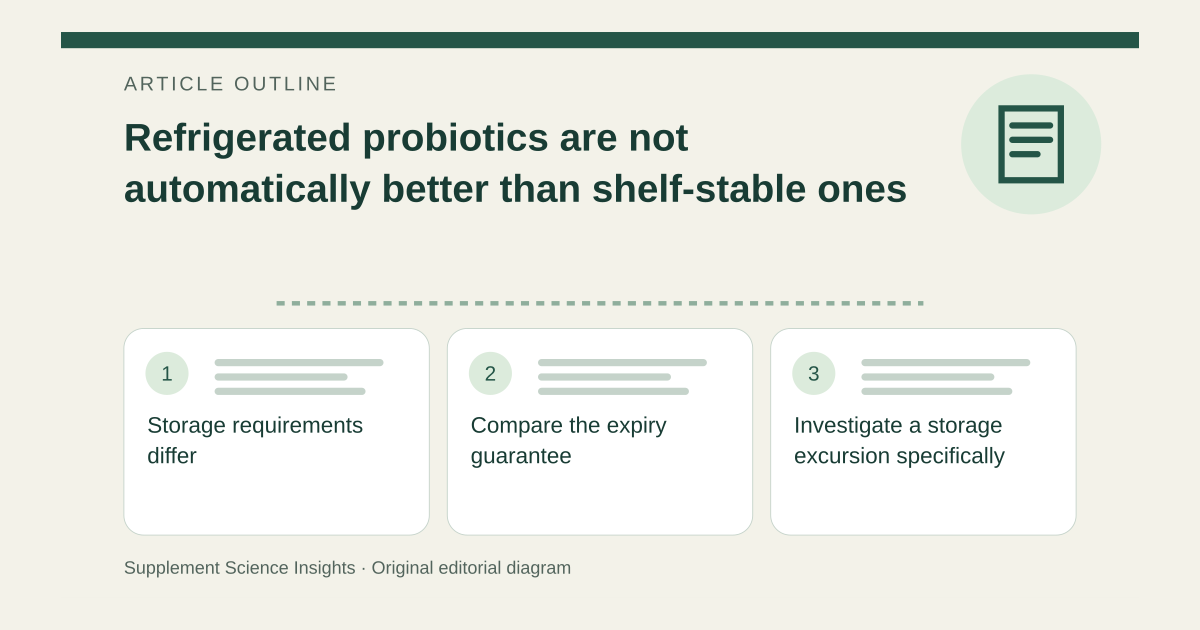
Storage requirements differ
ODS advises checking each product’s instructions because some probiotics need cold storage while others do not. A refrigerator shelf is therefore not a universal quality ranking. Formulation, packaging and the organism influence whether a viable count can be maintained under the stated conditions. [1]
Compare the expiry guarantee
A count measured only at manufacture does not account for decline over the product’s life. A count through the use-by date, under the labeled storage conditions, is more relevant to what a user receives. Neither a large initial number nor a refrigerated display establishes a demonstrated clinical effect. [1]
Investigate a storage excursion specifically
Imagine a product requiring refrigeration arrives warm. Ask the manufacturer about the actual exposure and lot rather than assuming all organisms are dead or that returning it to the fridge reverses any loss. A room-temperature product should likewise stay within its own directions, not in an overheated car because it is called shelf-stable. [1]
| Example | Interpretation |
|---|---|
| Refrigeration required | Maintain the specified cold storage |
| Room-temperature directions | Not unlimited heat tolerance |
| Count at manufacture | May not represent count at use |
Sources for this article
- Probiotics - Health Professional Fact Sheet
Source consulted: 2026-09-20. This is a reference resource, not a claim that we conducted the studies or tested a product.