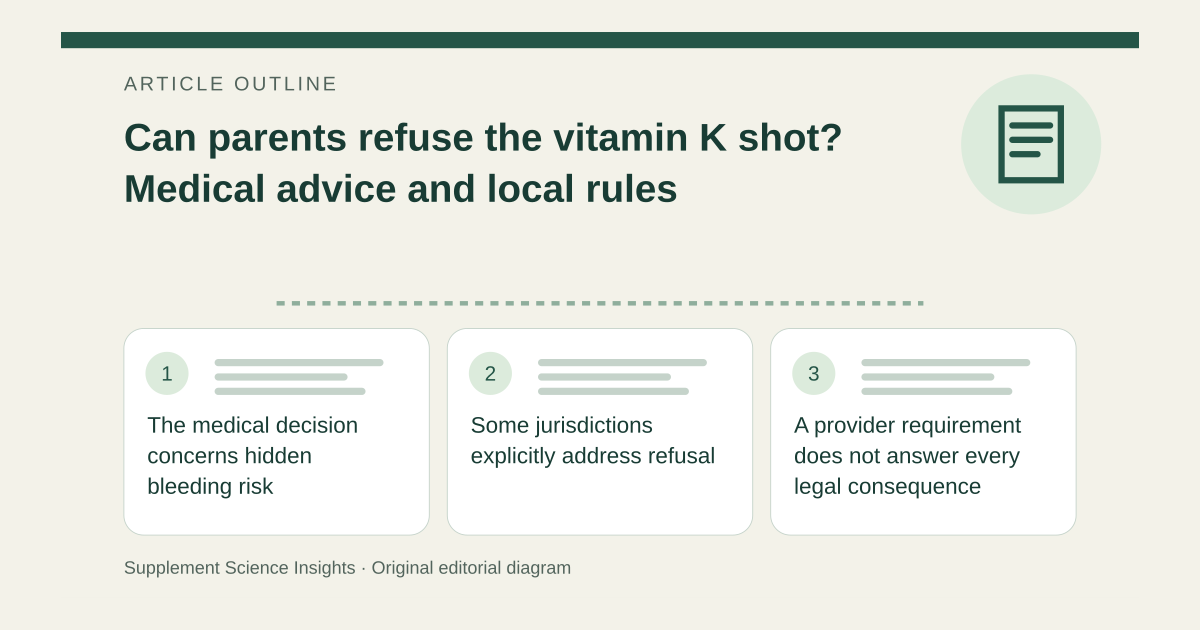
The medical decision concerns hidden bleeding risk
CDC explains that low vitamin K stores can lead to bleeding inside the brain or intestines before a parent sees an obvious warning. A healthy appearance does not identify which baby can safely go without prophylaxis. Discuss concerns before delivery when possible so the team can explain the benefits and product details. [1]
Some jurisdictions explicitly address refusal
Maine law requires intramuscular vitamin K within six hours and also requires a form on which a parent can refuse it. Oregon law requires vitamin K within twenty-four hours and describes a signed objection based on the parents’ religious tenets and practices. Those are different legal provisions, not one interchangeable national rule. [2][3]
A provider requirement does not answer every legal consequence
New York’s health department states that the provider must give vitamin K within six hours. That statement alone does not establish every step after refusal or every possible enforcement outcome. Ask the birth facility for its current policy and the applicable state guidance rather than rely on another family’s experience elsewhere. [4]
Refusal can affect other care arrangements
CHOP includes prior vitamin K among its office circumcision criteria. A refusal form does not oblige a clinician to provide every elective procedure on the original schedule. Oral vitamin K is also not considered an equivalent routine substitute in the inspected AAP guidance. [5][6]
Resolve the actual concern with the newborn team
Imagine parents worry about an ingredient but have only seen a generic online refusal form. Ask about the product to be used, the reason for prophylaxis and the local consent process. A form from a different state does not establish either medical safety or the rules at the planned birth location. [1][2][3]
| Question | Relevant source |
|---|---|
| Is prophylaxis medically recommended? | Pediatric and public-health guidance |
| What does state law require? | Current jurisdiction-specific law |
| How is refusal handled here? | Birth facility and applicable legal guidance |
| Will an elective procedure proceed? | The procedural team’s criteria |
Sources for this article
- Frequently Asked Questions About Vitamin K Deficiency Bleeding | Vitamin K Deficiency Bleeding | CDC
Source consulted: 2026-09-21. This is a reference resource, not a claim that we conducted the studies or tested a product. - Title 22, §1531: Care of infants after birth
Source consulted: 2026-09-21. This is a reference resource, not a claim that we conducted the studies or tested a product. - Oregon Revised Statutes
Source consulted: 2026-09-21. This is a reference resource, not a claim that we conducted the studies or tested a product. - Vitamin K Shot: Why does my newborn need it? - New York State Department of Health
Source consulted: 2026-09-21. This is a reference resource, not a claim that we conducted the studies or tested a product. - Circumcision | Children's Hospital of Philadelphia
Source consulted: 2026-09-21. This is a reference resource, not a claim that we conducted the studies or tested a product. - Why Your Newborn Needs a Vitamin K Shot - HealthyChildren.org
Source consulted: 2026-09-21. This is a reference resource, not a claim that we conducted the studies or tested a product.