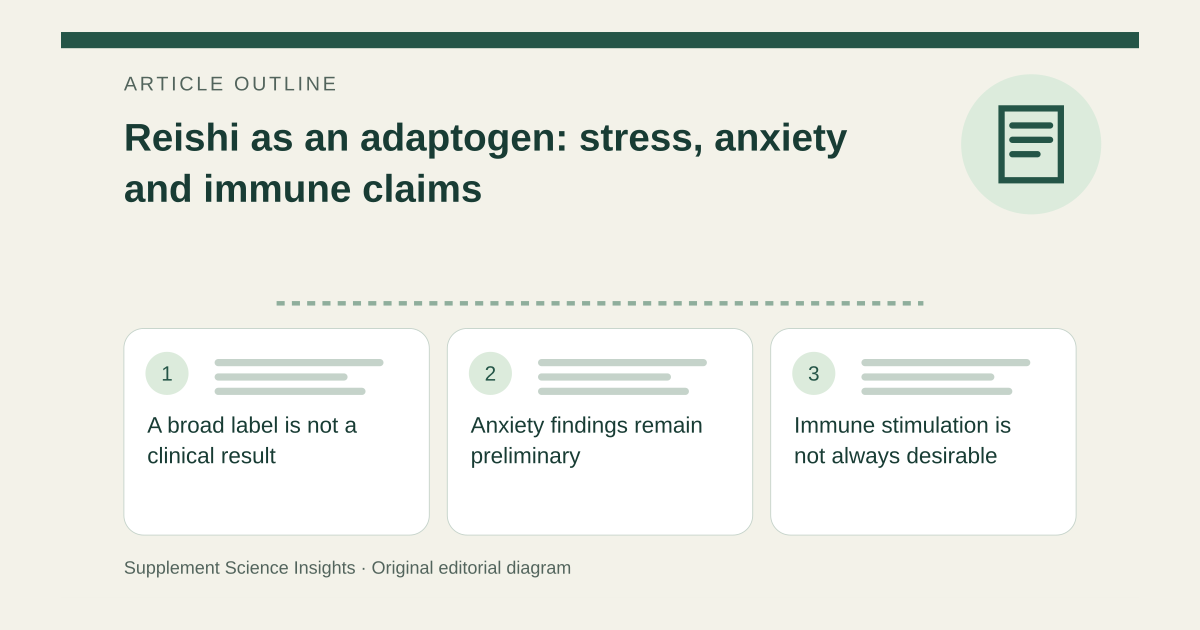
A broad label is not a clinical result
An adaptogen claim usually suggests helping the body cope with stress. For reishi, ask which symptom changed in which people using which preparation. OPSS cautions that mushroom supplement benefits and safety are not well established across products; a category name cannot substitute for that evidence. [1][2]
Anxiety findings remain preliminary
MSK’s clinical summary includes early findings involving anxiety, but it does not establish reishi as a standard treatment for an anxiety disorder. A small study in a defined group or a report of feeling calmer cannot predict benefit for everyone. There is no validated universal anxiety dose in the inspected guidance. [3]
Immune stimulation is not always desirable
Reishi compounds have immunomodulatory activity, but stronger immune signaling is not a universal health goal. MSK cautions about immunosuppressant interactions and possible autoimmune concerns whose causation is uncertain. People whose treatment intentionally suppresses immunity need a clinician’s review before using such products. [3]
Sleep claims need separate evidence
A relaxation claim does not establish an insomnia treatment. MSK lists insomnia among reported adverse effects of reishi, so it should not be assumed to be a dependable sedative. Persistent sleep problems call for assessment of causes and evidence-based sleep care. [3][4]
Review the whole risk profile
Bleeding interactions and liver injury reports matter alongside proposed stress benefits. Do not stop anxiety or other prescribed medication to try reishi, and bring the complete label to a pharmacist if a product contains several herbs or mushrooms. [3][2]
Choose a measurable question
Imagine a person with persistent anxiety and poor sleep sees a stress-resilience claim. The useful next step is to assess those symptoms and review the proposed product, not assume one adaptogen label validates two treatments. Any trial of a supplement needs a clear goal and a plan to address adverse effects. [2][3][4]
| Claim | Needed distinction |
|---|---|
| Calmer | Not necessarily an anxiety-disorder treatment |
| Immune support | Not always appropriate with immune suppression |
| Better sleep | Requires sleep-specific evidence |
Sources for this article
- Mushroom Dietary Supplements
Source consulted: 2026-09-21. This is a reference resource, not a claim that we conducted the studies or tested a product. - Dietary Supplements: What You Need to Know
Source consulted: 2026-09-21. This is a reference resource, not a claim that we conducted the studies or tested a product. - Reishi Mushroom | Memorial Sloan Kettering Cancer Center
Source consulted: 2026-09-21. This is a reference resource, not a claim that we conducted the studies or tested a product. - Insomnia - NHS
Source consulted: 2026-09-21. This is a reference resource, not a claim that we conducted the studies or tested a product.