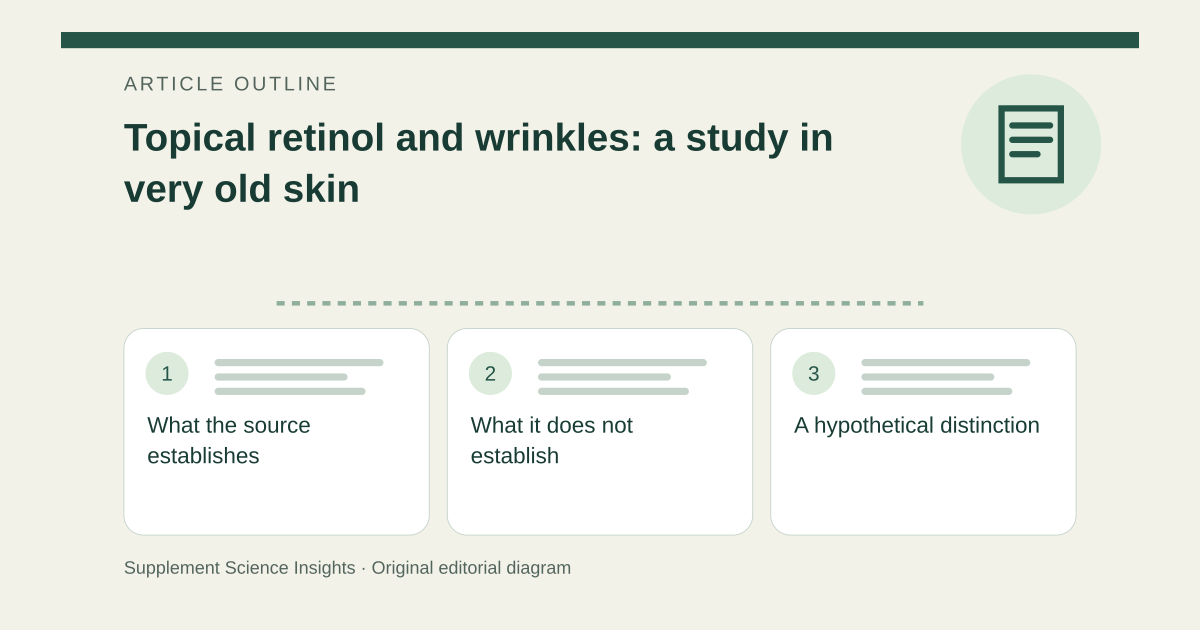
What the source establishes
Thirty-six older adults, averaging 87 years, received retinol lotion on one arm and its vehicle on the other. Staff applied the preparations for 24 weeks in a randomized, blinded comparison. [1]
Fine-wrinkle scores favored retinol. Biopsy measures of glycosaminoglycans and procollagen also changed, but those analyses involved only six and four participants respectively. [1]
What it does not establish
The analysis carried forward last observations, and very small biopsy subgroups limit mechanistic certainty. Arm skin in this population is not every skin type or formulation. Funding and conflicts were not established from the abstract; the trial did not demonstrate prevention of skin ulcers. [1]
A hypothetical distinction
Imagine a lotion improves a visible score while a few biopsy samples suggest a mechanism. The visible result and the small mechanistic sample deserve separate levels of confidence.
| Detail | Interpretation |
|---|---|
| Topical application | Not oral supplementation |
| Small biopsy subgroup | Mechanism remains limited |
| Other formulations | Separate evidence needed |
Sources for this article
- Improvement of naturally aged skin with vitamin A (retinol) - PubMed
Source consulted: 2026-09-19. This is a reference resource, not a claim that we conducted the studies or tested a product.