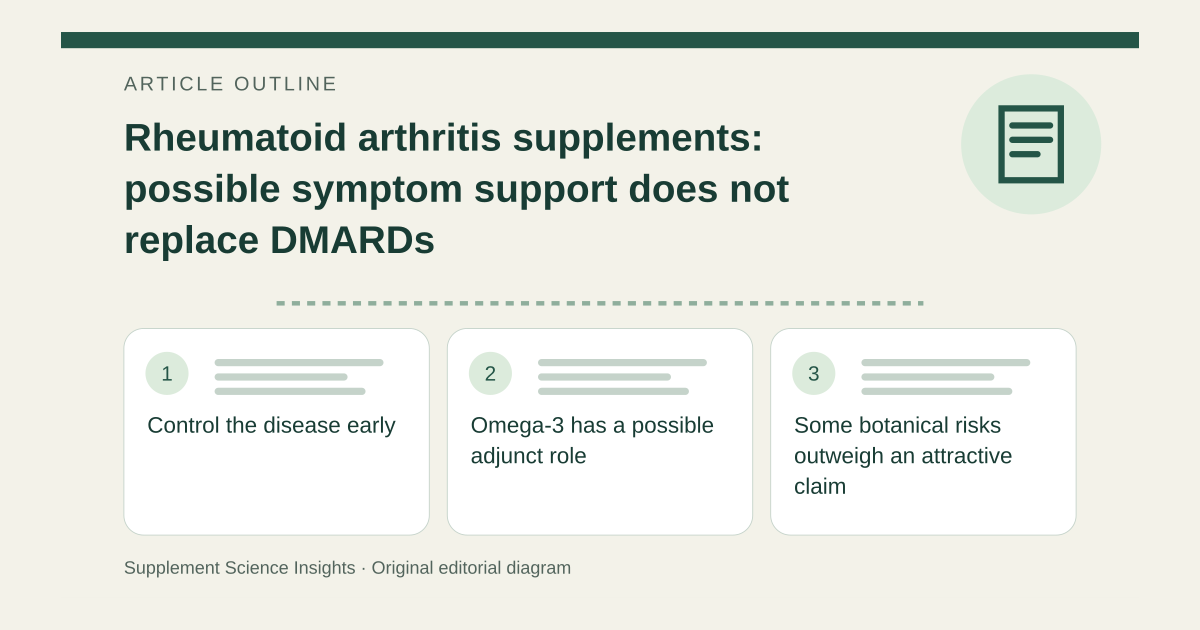
Control the disease early
NHS guidance describes disease-modifying antirheumatic drugs, or DMARDs, as a central treatment for rheumatoid arthritis. Pain relief and disease control are not identical goals. A person can feel somewhat better while still needing treatment to limit progression. [1]
Omega-3 has a possible adjunct role
NCCIH describes possible symptom benefit from omega-3 fatty acids and some other supplements. That is narrower than proof that a supplement prevents joint damage or can replace prescribed treatment. Discuss the formulation and goal with the rheumatology team. [2]
Some botanical risks outweigh an attractive claim
Thunder god vine has been studied for symptoms, but NCCIH highlights serious risks including reduced bone density and male infertility; improperly prepared extracts can be poisonous. A natural origin does not make it a safe self-treatment. [2]
Review combinations before starting them
Multi-ingredient arthritis products may differ from research preparations and can interact with medicines. Keep a complete list for the rheumatology team and pharmacist. Product testing does not establish disease-modifying benefit. [3]
Keep symptom tracking separate from treatment decisions
Imagine stiffness improves after a new product. Report that change, but do not reduce a DMARD independently. Disease activity and treatment monitoring should guide medication decisions, not a single subjective improvement. [1][3]
| Goal or finding | Meaning |
|---|---|
| Symptom improvement | Not equivalent to disease control |
| DMARD treatment | Protects against disease progression |
| Herbal arthritis product | Needs a specific safety review |
Sources for this article
- Rheumatoid arthritis - Treatment - NHS
Source consulted: 2026-09-20. This is a reference resource, not a claim that we conducted the studies or tested a product. - Rheumatoid Arthritis: In Depth | NCCIH
Source consulted: 2026-09-20. This is a reference resource, not a claim that we conducted the studies or tested a product. - Dietary Supplements: What You Need to Know
Source consulted: 2026-09-20. This is a reference resource, not a claim that we conducted the studies or tested a product.