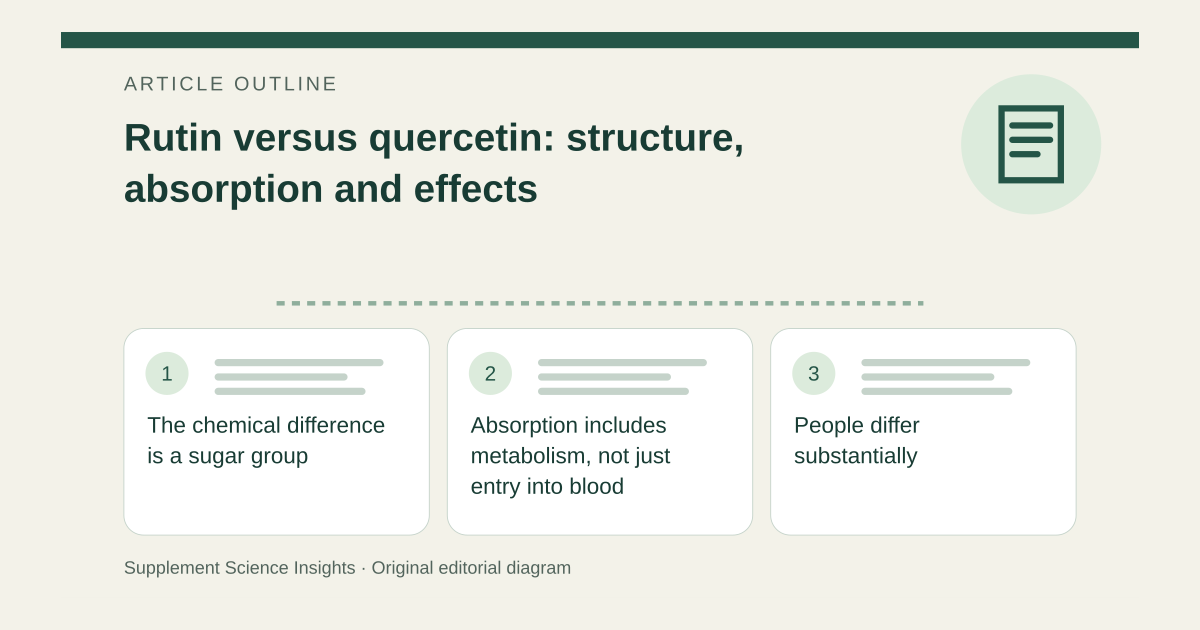
The chemical difference is a sugar group
Rutin is quercetin rutinoside: quercetin attached to rutinose. Free quercetin is the aglycone, without that attached sugar. Plant foods contain several quercetin conjugates, and a label using the broader word quercetin may not describe every formulation detail. [1]
Absorption includes metabolism, not just entry into blood
A human-bioavailability review describes intestinal absorption, gut-microbial breakdown and subsequent circulation of conjugated metabolites. Different chemical forms and food matrices affect these processes. Measuring a metabolite is not the same as showing that unchanged quercetin reaches every tissue. [2]
People differ substantially
The review found considerable variation between individuals and noted that many studies included few volunteers. Gut microbial metabolism can contribute to the differences. A simple claim that one form is always several times better ignores the specific preparation, measured compound and participant population. [2]
Compare outcomes as well as labels
Imagine two products contain the same number of milligrams, one labeled rutin and one quercetin. They contain different molecular forms and do not automatically deliver the same exposure. Choose based on evidence for the intended outcome and safety context, not the larger absorption slogan. [2][3]
| Feature | Why it matters |
|---|---|
| Attached rutinose | Different molecular form |
| Milligrams | Not automatically equivalent exposure |
| Metabolite measurement | Not direct proof of benefit |
| Clinical outcome | Requires formulation-specific evidence |
Sources for this article
- Quercetin and Its Anti-Allergic Immune Response - PMC
Source consulted: 2026-09-21. This is a reference resource, not a claim that we conducted the studies or tested a product. - Bioavailability of Quercetin in Humans with a Focus on Interindividual Variation.
Source consulted: 2026-09-21. This is a reference resource, not a claim that we conducted the studies or tested a product. - Safety Aspects of the Use of Quercetin as a Dietary Supplement.
Source consulted: 2026-09-21. This is a reference resource, not a claim that we conducted the studies or tested a product.