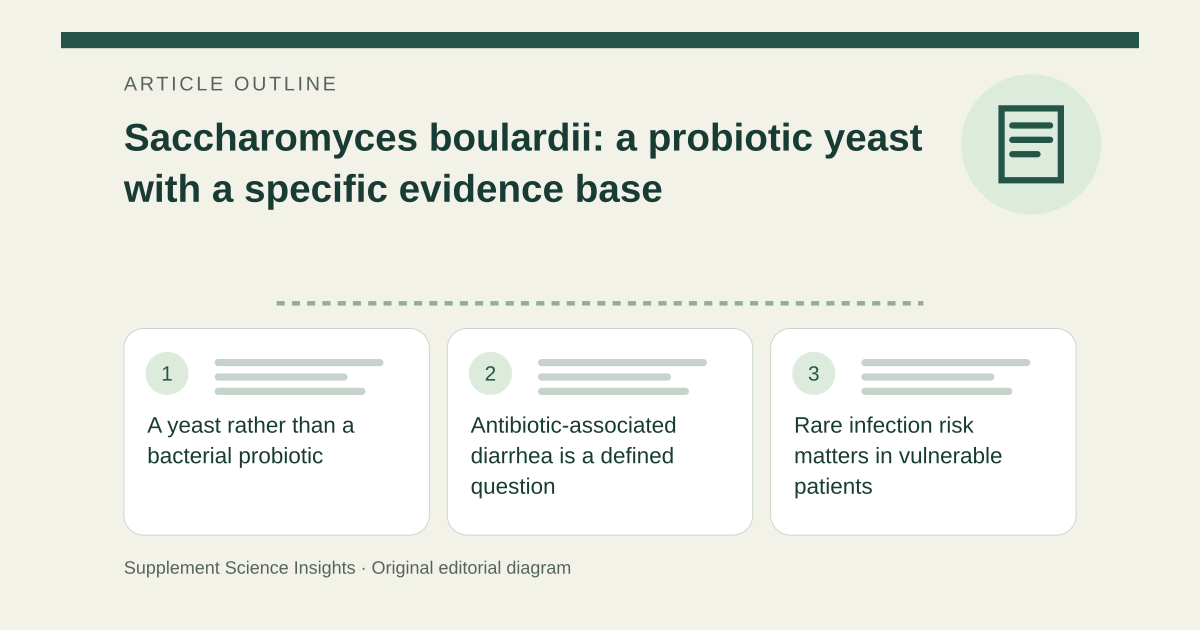
A yeast rather than a bacterial probiotic
Saccharomyces boulardii is a yeast used in probiotic preparations. The name identifies an organism, but a useful product comparison also needs the strain designation, formulation and viable count. Probiotics are not interchangeable simply because their packages promise digestive support. [1]
The NIH Office of Dietary Supplements emphasizes that effects can be strain-specific. A result obtained with a named preparation should not be transferred to an unidentified yeast powder or a different multi-organism mixture. [1]
Antibiotic-associated diarrhea is a defined question
ODS summarizes evidence that S. boulardii can reduce the risk of antibiotic-associated diarrhea in some studied populations. The effect depends on context, including age, treatment and setting. That finding does not mean everyone taking antibiotics needs the product or that it treats every cause of diarrhea. [1]
Preventing an episode during antibiotic treatment is different from treating an established infection. Likewise, evidence about acute diarrhea should not be repackaged as proof of general microbiome restoration. Keep the actual outcome and population attached to the claim. [1]
Rare infection risk matters in vulnerable patients
Probiotic-associated bloodstream infections, including fungemia involving Saccharomyces yeasts, have been reported. Many affected patients were severely ill, immunocompromised, in intensive care or had central venous catheters. These settings require clinical judgment rather than a routine supplement recommendation. [1]
A person with serious illness, impaired immunity or a catheter should not start a probiotic yeast without the treating team's direction. Absence of common side effects in healthier participants cannot rule out a rare but consequential infection in a different population. [1]
Read viable counts and storage instructions
Look for the complete organism identification and a viable count that applies through the end of shelf life under the stated storage conditions. A weight in milligrams does not directly tell you the number of live organisms, and a count at manufacture is not the same as a shelf-life guarantee. [1]
If a label does not disclose the strain or the basis of its count, note the missing information. A larger CFU number cannot repair an identity mismatch with the evidence. [1]
Absolute risk keeps a claim in perspective
Imagine a hypothetical comparison in which diarrhea occurs in 20 of 100 people without an intervention and 10 of 100 with it. That is a ten-percentage-point absolute difference and a 50% relative reduction.
This is not a reported S. boulardii trial result. It shows why both numbers matter: a relative percentage alone hides the starting risk. It also says nothing about whether the intervention is suitable for someone with a central line or another important risk factor. The safety question must be answered alongside the expected benefit.
| Hypothetical measure | Value |
|---|---|
| Comparison risk | 20% |
| Intervention risk | 10% |
| Absolute difference | 10 percentage points |
| Relative reduction | 50% |
Sources for this article
- NIH ODS — Probiotics, professional fact sheet
Source consulted: 2026-09-17. This is a reference resource, not a claim that we conducted the studies or tested a product.