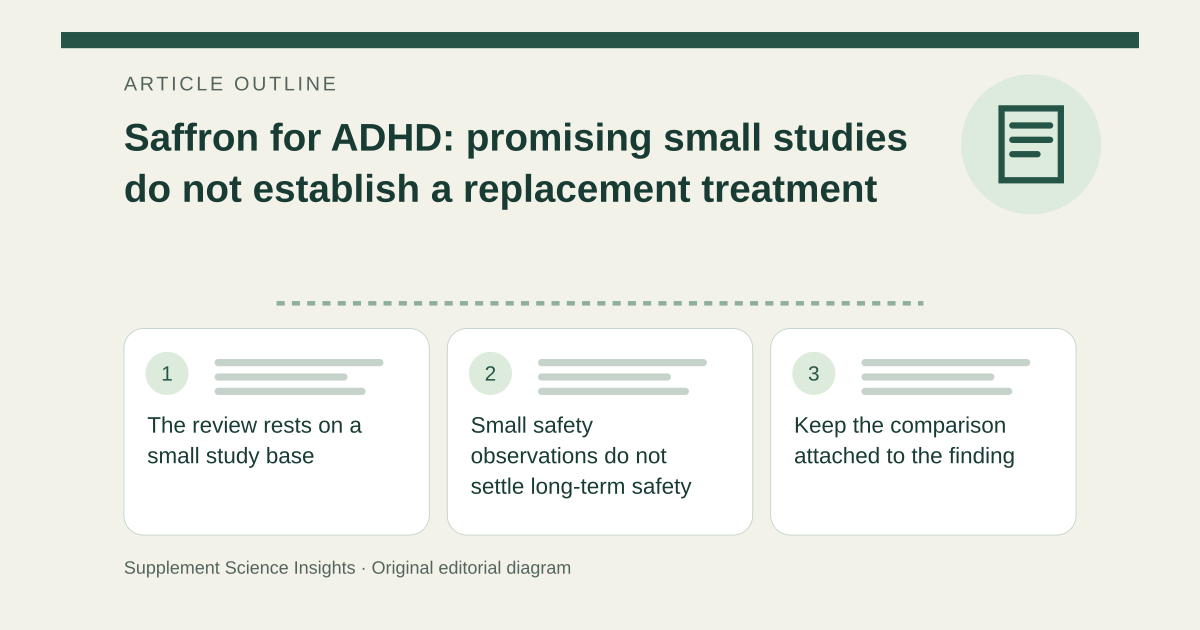
The review rests on a small study base
The review included four studies totaling 118 patients. It considered saffron both alongside methylphenidate and as a separate intervention, and its authors described the results as promising. [1]
Combining those contexts into one general claim would obscure different clinical questions. An adjunct study does not answer whether stopping an established treatment is effective. [1]
Small safety observations do not settle long-term safety
The authors reported no significant safety issues in the included studies and called for well-designed multicenter research. A small study base cannot reliably exclude uncommon harms or establish long-term outcomes. [1]
This page draws on the review abstract rather than a new appraisal of every trial. Discuss any proposed change with the clinician managing ADHD instead of treating a supplement label as an equivalent prescription. [1]
Keep the comparison attached to the finding
Imagine a study adds saffron to existing care. Even a favorable result would concern that addition, not prove that saffron alone can replace the background treatment.
| Detail | Interpretation |
|---|---|
| Four studies / 118 patients | Limited evidence base |
| Adjunct treatment | Different from replacement |
| Retail product | Requires exact preparation comparison |
Sources for this article
- The Effects of Crocus sativus (Saffron) on ADHD: A Systematic Review - PubMed
Source consulted: 2026-09-18. This is a reference resource, not a claim that we conducted the studies or tested a product.