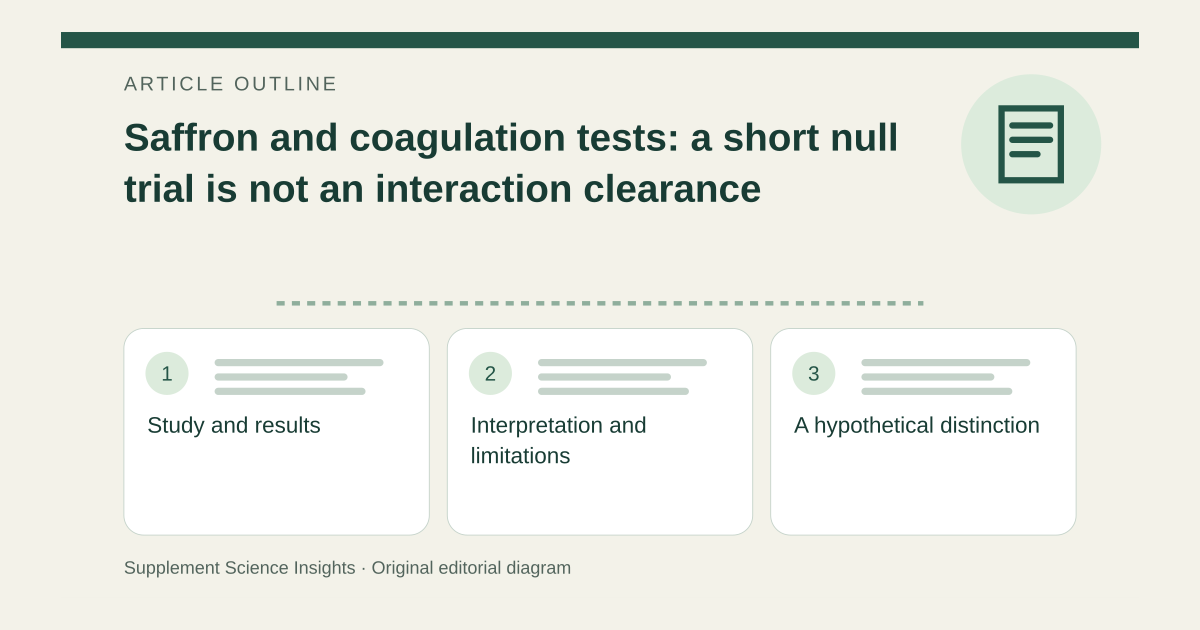
Study and results
Sixty adults were divided among placebo and two saffron-tablet groups in a double-blind study. Blood was sampled before treatment, after a week and again one month later. [1]
The measured panel included fibrinogen, factor VII, proteins C and S, prothrombin time and partial thromboplastin time. None showed a significant difference between groups. [1]
Interpretation and limitations
A laboratory panel in healthy volunteers does not capture every platelet effect or clinical bleeding event. The short duration also limits long-term inference. Funding and conflicts were not established from the abstract; the findings do not support using saffron as a blood thinner. [1]
A hypothetical distinction
Imagine several clotting tests remain unchanged. That answers the tests’ question under those conditions, not every possible medication interaction.
| Detail | Interpretation |
|---|---|
| Selected laboratory tests | No group difference |
| Clinical clot prevention | Not measured |
| Anticoagulant combination | Not tested |
Sources for this article
- Effect of Crocus sativus L. (saffron) on coagulation and anticoagulation systems in healthy volunteers - PubMed
Source consulted: 2026-09-19. This is a reference resource, not a claim that we conducted the studies or tested a product.