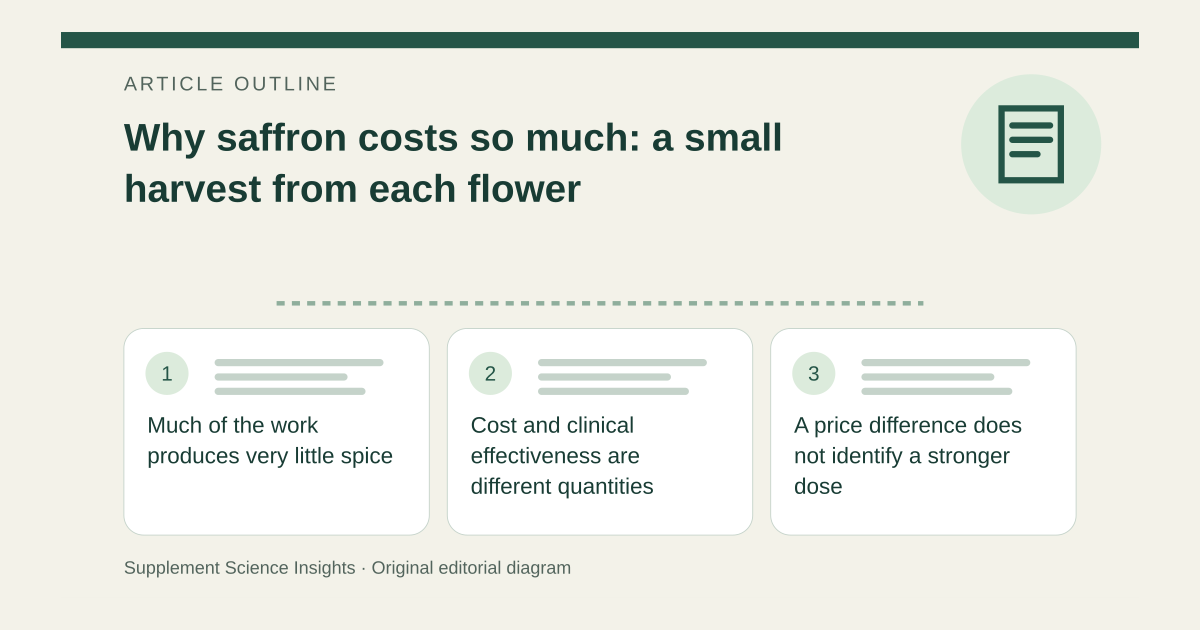
Much of the work produces very little spice
University of Vermont Extension describes handpicking individual flowers and carefully removing their three red stigmas. Drying those stigmas produces the familiar culinary spice. [1]
Its estimate of roughly 150 to 170 flowers for one gram illustrates the labor involved. This is an agricultural estimate, not a universal conversion for every growing and drying condition. [1]
Cost and clinical effectiveness are different quantities
The harvest process explains why a small weight can be expensive. It does not establish that a more expensive extract has a larger physiological effect or more reliable safety. [1]
For a supplement comparison, still identify the preparation, amount, composition and relevant outcome evidence. The price of raw spice cannot replace those details. [1]
A price difference does not identify a stronger dose
Imagine two saffron products have different prices per serving. Harvest cost may matter, but price alone cannot show which preparation matches a clinical study.
| Detail | Interpretation |
|---|---|
| Three stigmas | Small yield per flower |
| Hand separation | Labor requirement |
| High price | Not proof of clinical potency |
Sources for this article
- Saffron: World's Most Expensive Spice | University of…
Source consulted: 2026-09-18. This is a reference resource, not a claim that we conducted the studies or tested a product.