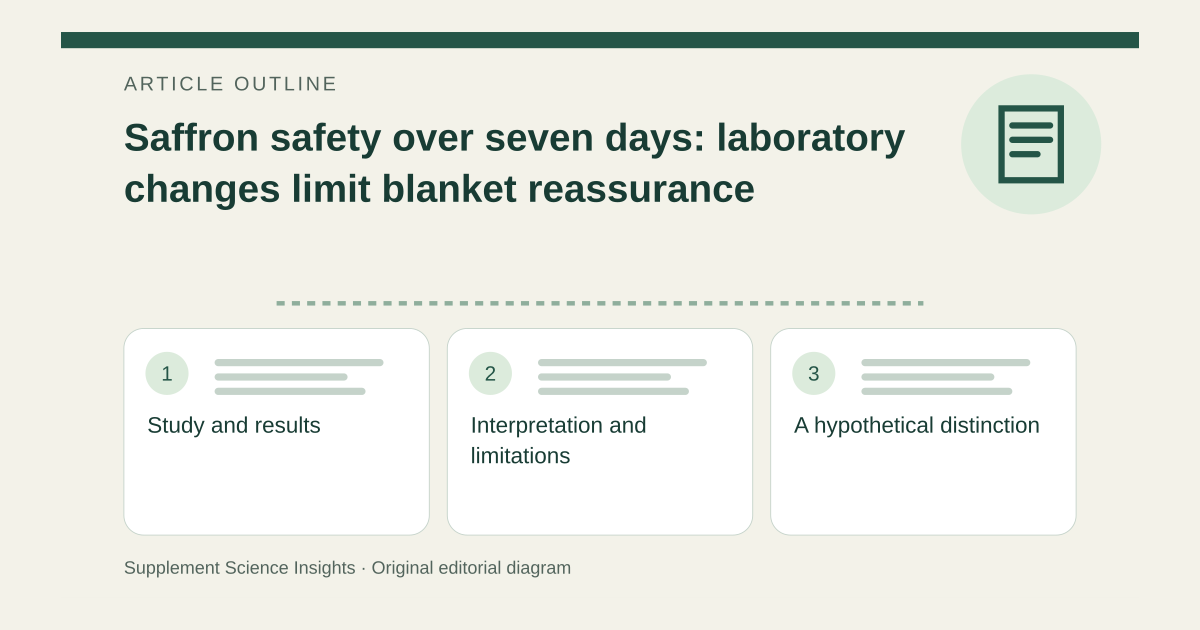
Study and results
Participants received placebo or one of two saffron-tablet amounts for seven days in a double-blind study. Investigators assessed clinical findings, blood tests and electrocardiographic measures before and after treatment. [1]
The higher amount reduced standing systolic and mean arterial pressure. Several blood-cell and biochemical measurements also changed, although the authors reported values remained within normal ranges. [1]
Interpretation and limitations
Normal-range results over one week do not rule out uncommon events, longer-term harms or risks in people with illnesses or interacting medicines. Funding and conflicts were not established from the abstract. The tested amounts are research exposures, not personal dosing recommendations. [1]
A hypothetical distinction
Imagine a small study observes no major clinical event. Its size and duration still determine how much reassurance that observation can provide.
| Detail | Interpretation |
|---|---|
| Seven days | Short observation window |
| Healthy volunteers | Selected population |
| No major observed event | Not proof of universal safety |
Sources for this article
- Safety evaluation of saffron (Crocus sativus) tablets in healthy volunteers - PubMed
Source consulted: 2026-09-19. This is a reference resource, not a claim that we conducted the studies or tested a product.